

- This topic is empty.
-
AuthorPosts
-
2026-10-28 at 5:14 pm #12813
For telecom operators, ISPs, and broadband network companies, keeping customer-premises equipment online during power disruptions is a fundamental service priority. A mini UPS — a compact, device-side backup power unit — is the most practical line of defense against outages that cause routers, ONTs, modems, and gateways to reboot or lose service. Yet choosing the wrong unit based on mismatched voltage, insufficient current, or incorrect connectors can turn a promising deployment into a costly field problem.
This guide walks through the critical technical and practical factors that professionals should evaluate before purchasing a mini UPS for broadband or telecom applications.
Understand the Target Device’s Electrical Requirements
The first and most important step is accurately identifying the power profile of the equipment being protected. Three parameters must be confirmed before any product selection.
Output voltage is the starting point. Most home routers, ONTs, and CPE devices operate on 12V DC. Deploying a unit with a mismatched output voltage will either fail to power the device or risk equipment damage.
Working current defines how much continuous power the device draws under normal operation. Selecting a mini UPS rated at 2.5A continuous output for a device that regularly pulls 3.5A or more will result in performance failure or premature shutdown. High-performance WiFi 6/7 routers and storage-integrated gateways, for example, can exceed the thresholds that standard-output units are designed to handle.
Peak or startup current is often overlooked but critically important. Many network devices draw a surge of current at startup that is significantly higher than their steady-state consumption. A mini UPS that cannot handle this transient load may fail to keep the device running at the exact moment the outage occurs — defeating the entire purpose of the investment.
Getting these three values confirmed before comparing products reduces the most common and costly selection errors in field deployments.
Match Battery Capacity to Runtime Expectations
Once a device’s power requirements are understood, the next question is how long the backup needs to last. Battery capacity in a mini UPS is measured in Wh (watt-hours), and real-world runtime depends on both the battery energy and the actual load being drawn.
For short outages — typical grid blips or voltage drops lasting a few minutes — a unit with 18–30Wh may be entirely sufficient. For residential areas or remote locations where outages may extend for hours, deploying units with 75Wh or more becomes a more appropriate choice. Oversizing battery capacity for a lightweight load adds cost without meaningful benefit; undersizing it guarantees subscriber complaints during longer events.
MYLION, a Shanghai-based B2B provider of mini UPS products and DC backup power solutions for telecom, ISP, and broadband applications, structures its portfolio around this consideration. Its 12V Standard Series covers 18.72Wh to 44.4Wh, while the 12V Long-Runtime Series reaches 75.6Wh — designed specifically for extended outage scenarios. Understanding actual runtime needs before procurement helps avoid both over-investment and underperformance.
Evaluate Output Current Rating Against Load Profile
Beyond battery size, the output current rating of a mini UPS must match the device’s actual power draw. Two specifications are relevant: continuous output current and maximum (peak) output current.
A unit rated at 2.5A continuous with a 3A maximum is well-suited for standard CPE devices. However, for high-power equipment such as tri-band routers or gateways with integrated storage, a unit capable of 4A continuous and 5A maximum may be required. Choosing a unit that only handles peak loads intermittently — rather than sustaining them — risks thermal shutdown or inconsistent backup behavior.
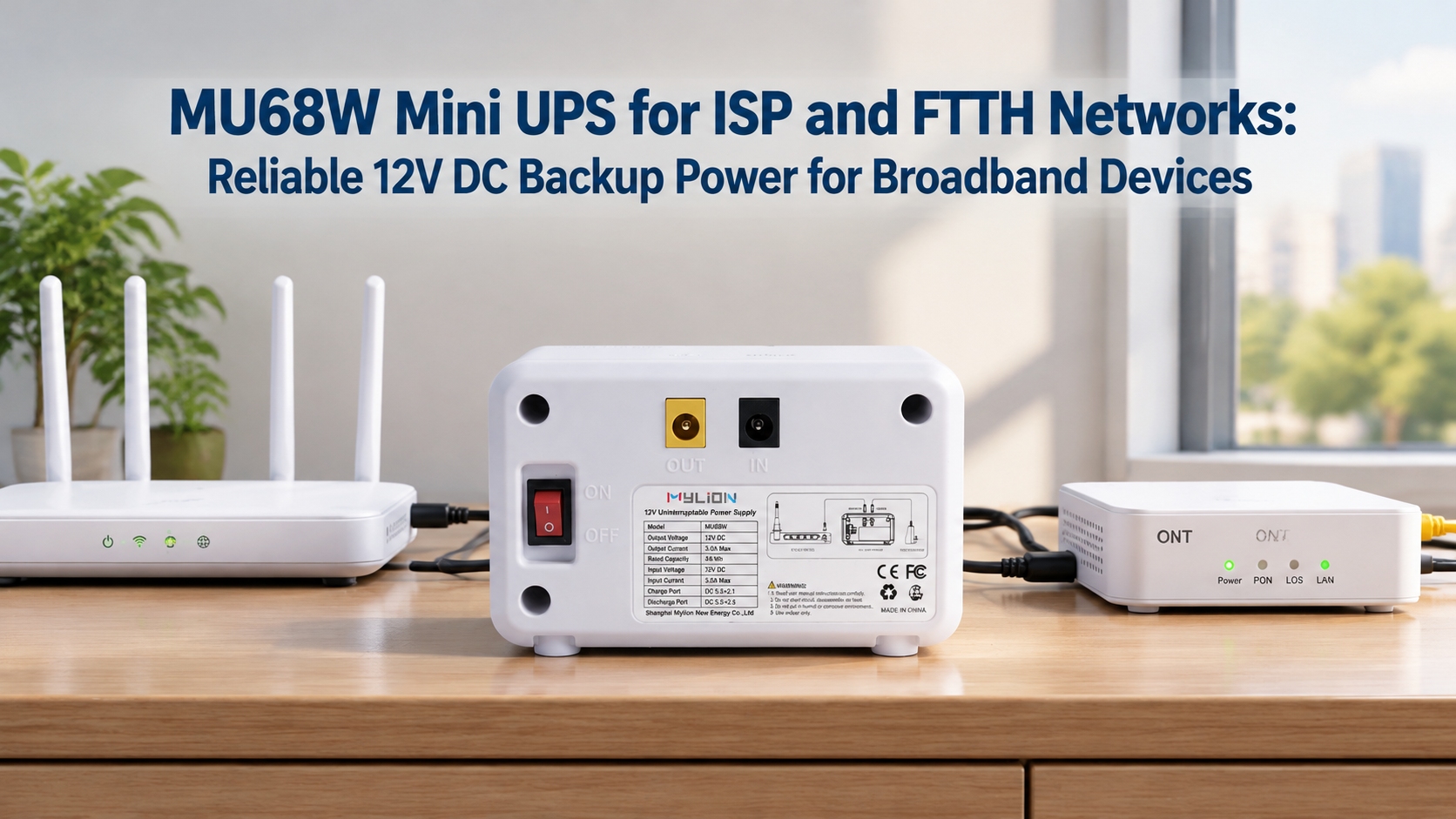
MYLION’s 12V High-Power Series includes units capable of 60W total output (4A continuous / 5A maximum), designed for these higher-demand applications. The corresponding 12V High-Power Long-Runtime Series combines that current capacity with 75.6Wh battery energy for professional gateways requiring both high peak current and extended backup duration.
Verify Connector and Cable Compatibility
One of the most practically underestimated factors in mini UPS procurement is connector compatibility. Network equipment manufacturers use a variety of DC barrel connectors — most commonly DC5521 and DC5525 — with differences in pin dimensions and polarity that directly affect reliable contact.
Deploying units with mismatched connectors leads to intermittent connections, unreliable charging, or a complete failure to power the target device. For large-scale ISP or operator rollouts, connector mismatches multiply into a significant field service burden. Confirming the exact connector specification for each device type before placing an order is an essential step that is frequently bypassed — and frequently regretted.
Consider Multi-Device and Multi-Output Scenarios
In many subscriber installations, more than one device needs backup coverage. A typical fiber broadband setup includes both an ONT and a router — two independent 12V loads. Selecting a mini UPS that can support both from a single unit simplifies wiring and reduces equipment count on-site.
For scenarios involving both a 12V device and a USB-powered accessory, multi-output mini UPS units provide simultaneous backup for both load types within a defined system power limit. MYLION’s 12V + USB Multi-Output Series supports combined 12V DC and 5V USB-A/USB-C outputs, subject to an 18W total system limit — appropriate for SOHO environments or compact office setups.
For dual-device 12V installations powered directly from an AC wall outlet, MYLION’s ML1202AC offers an AC-input design using LiFePO4 battery chemistry with dual 12V DC outputs (2A each; 24W total system limit), eliminating the need for a separate DC adapter. It is particularly well-suited for combined ONT and router installations.
Factor in Battery Chemistry
Battery chemistry affects both cycle life and suitability for always-on deployment conditions. LiFePO4 (lithium iron phosphate) offers improved thermal stability and a longer cycle life compared to standard lithium-ion chemistries, making it a preferred choice for installations where units remain on charge continuously — as is standard in telecom and broadband CPE deployments.
When evaluating mini UPS options for high-volume or long-term contracts, battery chemistry is a specification worth explicitly confirming in product documentation, not simply assumed.
Account for Emerging Device Power Standards
As WiFi 6 and WiFi 7 routers and modern CPE equipment increasingly adopt USB-C Power Delivery as their power input standard, the traditional DC barrel connector approach will not be universally applicable. Procurement pipelines that extend 12 to 24 months into the future should evaluate whether backup power solutions with USB-C PD input and output are available for advance testing.
MYLION’s development direction includes the MUC85, a USB-C PD Mini UPS supporting up to 100W input and 65W output, currently available for project evaluation. For higher-voltage applications — such as wireless CPE and radio bridge equipment — the MU248 development direction targets independent 24V (3A) and 48V (1A) outputs using LiFePO4 chemistry with 102.4Wh battery energy and 100W total system capacity.
Work with a Supplier That Supports Technical Validation
Given the number of variables involved — device voltage, working current, peak behavior, connector type, battery chemistry, and runtime expectations — selecting a mini UPS for a professional deployment is not a straightforward catalog exercise. It requires technical confirmation for each device type and installation environment.
MYLION operates specifically as a B2B backup power partner for telecom operators, ISPs, system integrators, and OEM/ODM customers, offering requirement analysis, model matching, sample testing support, connector and cable matching, and documentation coordination as part of its project support model. Further information is available at http://www.myliontech.com.
For procurement teams evaluating mini UPS solutions at deployment scale, the safest approach is to validate samples against actual field devices before committing to mass production — a step that surfaces compatibility issues before they become deployment problems rather than after.
http://www.myliontech.com
Shanghai Mylion New Energy Co.,Ltd. -
AuthorPosts

- You must be logged in to reply to this topic.