

- This topic is empty.
-
AuthorPosts
-
2026-10-28 at 5:14 pm #12814
Why Electrical Specifications Alone Are Never Enough
When B2B equipment manufacturers begin sourcing lithium battery packs, the instinct is often to lead with a specification sheet — voltage, capacity, and form factor — and expect the battery to perform reliably once installed. In practice, however, a technically accurate specification does not guarantee that a battery will function correctly inside a real device under real operating conditions. The gap between a datasheet and a deployed product is precisely where most battery-related project failures originate.
Real device testing — validating a battery pack within the actual target device, under actual load profiles and environmental conditions, before committing to mass production — has become a recognized engineering discipline among serious B2B battery development partners. Understanding why this step is non-negotiable requires examining what electrical specifications fundamentally cannot predict.
The Hidden Variables That Specifications Cannot Capture
A battery specification defines steady-state electrical parameters. What it cannot capture is dynamic system behavior: how a battery pack interacts with the device’s motor controller during startup surges, how the BMS responds to a rapid discharge event, how heat builds up inside a sealed enclosure, or how connector resistance changes under repeated insertion cycles.
Peak current demand is one of the most commonly underestimated variables. Many devices — particularly those containing motors, actuators, or communication radios — draw current in sharp pulses that far exceed the device’s rated average load. A battery pack that is correctly sized for average consumption may trigger BMS overcurrent protection or experience voltage sag during these peaks, causing the device to shut down unexpectedly. Without testing under real load conditions, this failure mode remains invisible until it appears in the field.
Thermal behavior is another variable that emerges only through integrated testing. A battery that dissipates heat acceptably on an open test bench may exceed safe temperature thresholds inside a sealed enclosure where airflow is restricted. Thermal accumulation across charge-discharge cycles, particularly in compact device housings, is a risk that cannot be modeled through electrical parameters alone.
BMS compatibility is a third area where assumptions frequently break down. The battery management system must be matched not only to the cell chemistry and pack voltage, but also to the charger’s charging profile, the device’s communication protocol, and the specific protection thresholds required by the end application. A BMS that balances and protects correctly in isolation may generate false fault conditions or fail to communicate status when integrated with a particular device architecture.
What Structured Pre-Production Validation Actually Involves
For engineering-driven battery development partners, pre-production validation is not a single test event — it is a structured stage within the overall project workflow. This stage typically follows requirement confirmation and prototype development, and it precedes specification freeze and mass-production release.
Effective validation covers several distinct technical domains:
Load profile testing involves running the battery under the actual discharge pattern of the target device — including startup surges, sustained operation cycles, and deep-discharge scenarios — to confirm that the pack architecture, cell selection, and BMS configuration perform as intended.
Thermal mapping confirms that the pack operates within safe temperature limits under worst-case usage conditions, with particular attention to heat generation inside the device enclosure.
BMS function verification checks every protection and communication function of the battery management system against the device’s actual electrical environment — including compatibility with the charger, accuracy of the state-of-charge monitoring, and correct response to fault conditions.
Mechanical integration review ensures that the enclosure, mounting hardware, connector positions, and cable routing do not create assembly conflicts or introduce stress points that could compromise reliability over the product’s operational life.
Environmental stress screening, where applicable, exposes the assembly to vibration, humidity, or temperature cycling conditions representative of the end-use environment — a requirement that is especially important for agricultural, outdoor, and industrial applications.
Each of these domains is addressed during the sample validation stage, with results reviewed against the project’s approved requirements before production specifications are finalized.
Consequences of Skipping Device-Level Testing
The business cost of bypassing real device testing is well documented across B2B equipment sectors. Field failures that trace back to peak-current incompatibility, thermal overload, or BMS misconfiguration are notoriously difficult and expensive to resolve after mass production has commenced. Recall campaigns, re-engineering cycles, and supply-chain disruptions represent direct financial losses. Regulatory non-compliance — particularly for devices requiring transport documentation such as UN38.3 — can result in shipment delays or market access restrictions.
Beyond direct costs, engineering credibility suffers when a product reaches market with battery issues that should have been resolved at the prototype stage. B2B customers and system integrators building downstream products on a platform expect the battery to be a validated, stable component, not a source of field variability.
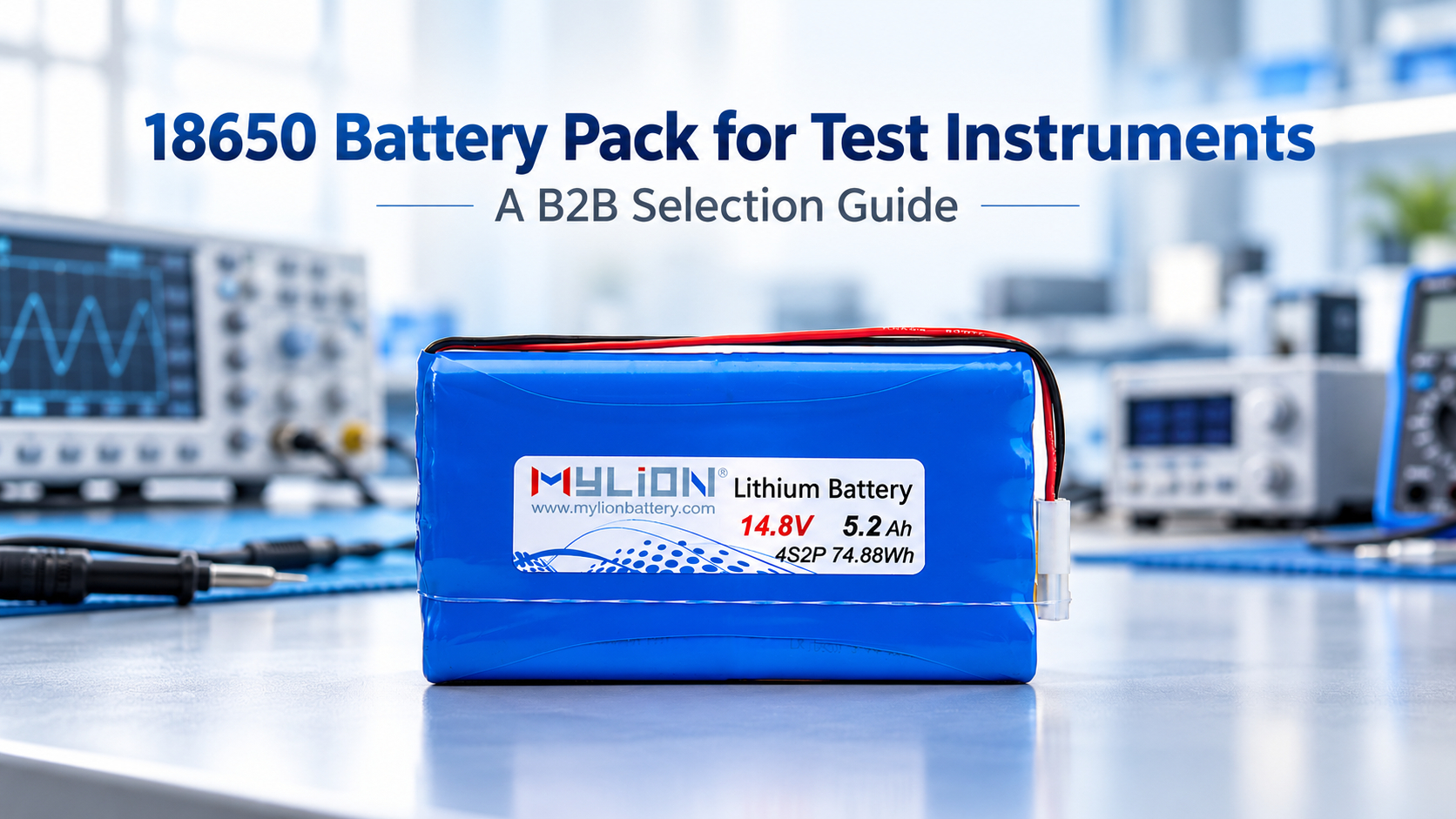
How MYLION Structures Validation Into the Engineering Process
MYLION — the battery brand of Shanghai Mylion New Energy Co., Ltd. — approaches battery development as an engineering discipline in which the battery is treated as an integral component of the customer’s entire system, not as a standalone electrical product. With 13+ years of lithium battery industry experience, MYLION has built its project methodology around the principle that requirement definition, prototype development, and sample validation must occur as controlled, sequential stages before any mass-production specification is approved.
During the validation phase, MYLION evaluates the battery pack’s behavior against the real load, the actual charging source, the specific BMS functions required, and the mechanical constraints of the device housing. Discovered discrepancies — whether in peak-current handling, thermal performance, or connector compatibility — are resolved through engineering review rather than production workarounds.
MYLION’s service scope covers the full project cycle: from initial requirement analysis and feasibility review through solution definition, prototype development, testing support, specification approval, and mass-production coordination. Change-control management and version-controlled BOMs ensure that validated specifications remain stable through repeat-order cycles, eliminating the configuration drift that frequently introduces reliability issues over a product’s commercial lifetime.
This structured model directly addresses the industry pain point that many B2B customers face: incomplete or conflicting requirements that lead to thermal issues, selection errors, and certification delays when untested assumptions reach production.
The Engineering Standard That Protects Long-Term Product Reliability
Real device testing before battery mass production is not a discretionary quality step — it is the engineering mechanism through which abstract specifications are converted into verified, production-ready components. For B2B equipment manufacturers, selecting a battery development partner that embeds this validation stage into its standard project process is one of the most consequential supply-chain decisions a product team can make.
The alternative — proceeding to mass production on the basis of specification compliance alone — leaves a predictable set of failure modes unresolved and transfers the cost of discovering them from the development phase to the field, where resolution is invariably more expensive, more disruptive, and more damaging to product reputation.
More information on MYLION’s custom battery development process is available at http://www.mylionbattery.com.
Shanghai Mylion New Energy Co.,Ltd. -
AuthorPosts

- You must be logged in to reply to this topic.