

- This topic is empty.
-
AuthorPosts
-
2026-10-16 at 3:20 pm #12288
Why Insulator Selection Is Critical for High-Breaking-Capacity DC Fuse Bases
High-breaking-capacity (HBC) DC fuses are increasingly deployed in solar photovoltaic string combiner boxes, battery energy storage system (BESS) racks, EV fast-charging power distribution units, and 1,500V DC utility-scale arrays. Unlike AC overcurrent protection devices that interrupt current at a natural zero-crossing point, DC fuses clear fault energy at system voltage without periodic current interruption. This imposes a dual mechanical and dielectric demand on any structural insulator used as the mounting base: the insulator must physically retain the fuse body against fault-current electrodynamic expulsion forces, and it must simultaneously withstand the steep-fronted surge overvoltage transients generated the instant the fusible element ruptures.
Selecting an insulator that fails either test — mechanical retention or impulse withstand — produces identical outcomes in field service: arc tracking along a carbonized creepage path, busbar-to-ground flashover, or catastrophic structural disengagement that exposes live conductors. Understanding how purpose-engineered DC fuse mounting insulators address both failure modes is therefore a foundational step for any panel builder, EPC contractor, or power electronics integrator designing around HBC DC protection.
The Mechanical Retention Problem: Electrodynamic Forces and Vibration
When an HBC DC fuse clears a high-impedance fault, the electromagnetic forces acting on the current path are proportional to the square of the fault current amplitude. At 1,000A to 6,300A fault levels, these forces manifest as abrupt mechanical shocks on the fuse mounting base. A standard cylindrical standoff insulator without anti-rotation features can experience rotational shear at the mounting plate interface, loosening the threaded insert and allowing the fuse body to shift position — exactly the scenario that defeats the geometric creepage requirements engineered into the switchgear panel.
DOWE Electric (Yueqing City Duwai Electric Co., Ltd.) addresses this problem directly in the SB / JYZ Series standoff insulator family. Each unit in this family integrates a hexagonal anti-rotation base with a cylindrical upper body. The hexagonal geometry allows an assembly technician to hold the base firmly with a standard open-end wrench while applying full tightening torque to the mounting fastener, which eliminates rotational shear stress on the mounting plate during both initial installation and post-fault inspection re-torquing. This is not a styling feature — it is a structural engineering decision that directly prevents the base rotation failure mode that plain cylindrical standoffs cannot resist.
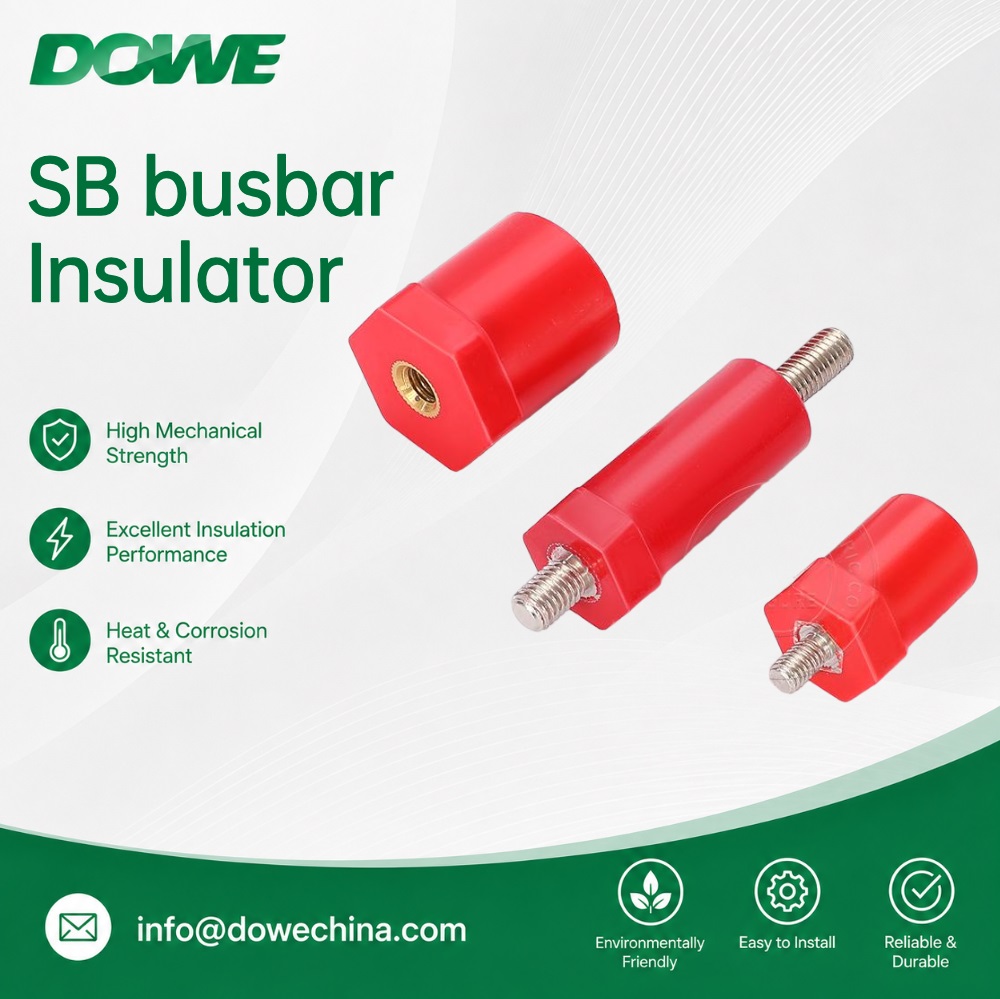
The pull-out resistance of the DOWE SB / JYZ Series threaded inserts — cold-pressed brass H62 or zinc-plated high-tensile steel — exceeds 8,000 N for M8 and M10 insert configurations. Torsional lock performance exceeds 1.5 times the rated bolt proof torque. These mechanical thresholds are verified through third-party SGS type testing, which means panel builders can reference those test reports in Design Verification documentation without commissioning independent destructive pull-out testing.
Impulse Withstand: Clearing Transients Without Surface Tracking
The second failure mode — impulse-induced surface tracking — is often underestimated in DC fuse mounting applications. When an HBC fuse ruptures, it generates a fast-rising voltage transient across the fuse terminals that can reach multiples of the system operating voltage. IEC 60664-1 categorizes the required impulse withstand level based on overvoltage category and rated system voltage; for DC distribution switchgear at 1,500V DC, Overvoltage Category IV per IEC 60664-1 requires impulse withstand capability at the highest severity class.
DOWE SB / JYZ insulators are rated to withstand a 1.2/50 μs impulse overvoltage up to 8 kV under Overvoltage Category IV per IEC 60664-1. Low-voltage dielectric withstand testing confirms 3,500V AC at 50 Hz for one minute without puncture or flashover across the insulator body. These ratings confirm that the material system — high-grade DMC / BMC / SMC composite — maintains dielectric integrity through the steep transient energy released during fuse interruption.
The material group designation is equally critical. DOWE SB / JYZ Series achieves a Comparative Tracking Index (CTI) of 600V or higher, placing it in Material Group I. At this CTI level, the insulator surface resists the formation of conductive carbonized tracking paths even in the presence of contamination films that form in dusty solar installations or humid battery container environments. A material that tracks under contamination will eventually bridge the creepage path regardless of initial dielectric clearance — Material Group I construction eliminates this degradation mechanism.
Dimensional Range Across HBC DC Fuse Mounting Configurations
DOWE Electric offers the SB / JYZ Series in seven body diameter classes — SB14 (14 mm) through SB60 (60 mm) — each covering a specific range of available heights and thread specifications. For DC fuse mounting bases that require compact spacing in dense power conversion racks, SB20 (JYZ-20) provides a 20 mm body diameter with heights spanning 16 mm to 90 mm and thread options in M5, M6, and M8, fabricated from high-strength BMC. For heavier-duty structural fuse bases where multiple parallel busbars converge at the fuse terminal, SB40 (JYZ-40) and SB60 (JYZ-60) offer 40 mm and 60 mm body diameters respectively, constructed from high-strength SMC using longer glass fiber reinforcement (25 mm to 50 mm fiber length), with M8/M10 and M12/M16 thread interfaces rated for tightening torques up to 95 N·m working value for M16 fasteners.
This dimensional ladder allows design engineers to select the appropriate insulator body size based on busbar-to-backplate distance, mechanical load class, and available panel real estate — without resorting to custom tooling for intermediate heights.
Thermal and Environmental Performance for DC Fuse Environments
DC fuse mounting assemblies in battery containers and outdoor solar combiner boxes experience continuous thermal cycling as ambient temperatures and load currents fluctuate. DOWE SB / JYZ insulators maintain structural integrity across an operating temperature range of -40°C to +140°C, preventing both low-temperature embrittlement during cold-start battery activation and high-temperature structural softening during peak summer generation cycles.
The Heat Deflection Temperature (HDT) of the BMC/SMC material system maintains structural rigidity under a 1.8 MPa flexural load up to +180°C. The Coefficient of Thermal Expansion (CTE) falls between 15 and 22 × 10⁻⁶ /K, intentionally matched to copper (16.5 × 10⁻⁶ /K) and aluminum (23.1 × 10⁻⁶ /K) busbar conductors. This CTE alignment minimizes differential thermal expansion stress at the insulator-busbar contact interface through millions of thermal cycles over the service life.
UL 94-V0 flammability certification — with afterflame time t1 plus t2 no greater than 8 seconds and zero flaming drips — directly addresses fire safety requirements for enclosed energy storage cabinets where fuse-based protection is the primary fault interruption mechanism.
Compliance Foundation for Cross-Border Market Entry
Panel builders integrating DOWE SB / JYZ Series insulators into DC fuse mounting assemblies benefit from the full compliance envelope that accompanies the product family. RoHS 2011/65/EU and 2015/863 compliance, REACH EC 1907/2006 compliance, CE clearance, and SGS third-party type test clearance collectively remove the primary certification barriers for European and North American market entry. Relative Thermal Index (RTI) certification per UL 746B at 130°C for both electrical and mechanical properties documents long-term material stability in sustained elevated-temperature service — a requirement for UL-listed switchgear assemblies in North American markets.
DOWE Electric’s production capacity exceeds 500,000 low-voltage standoffs per month, with millions of SB / JYZ insulators exported annually to solar inverter OEMs, battery pack integrators, and switchgear builders across Germany, the United States, Spain, Italy, the Netherlands, and Canada. This volume validates both dimensional consistency and material batch stability at the production scale that high-volume DC fuse assembly lines require.
For engineers specifying insulator solutions for HBC DC fuse mounting applications, the combination of hexagonal anti-rotation retention geometry, 8 kV impulse withstand capability, Material Group I CTI of 600V or higher, and a documented compliance portfolio positions DOWE Electric’s SB / JYZ Series as a technically grounded choice across the full range of 1,500V DC solar, BESS, and EV charging infrastructure deployments.
http://www.busbarinsulator.com
Yueqing City DUWAI Electric Co.,LTD -
AuthorPosts

- You must be logged in to reply to this topic.