

- This topic is empty.
-
AuthorPosts
-
2026-10-14 at 5:22 pm #12226
Understanding the Free-to-Total PSA Ratio
- Free-to-Total PSA Ratio (F/T ratio): a calculated value obtained by dividing free prostate-specific antigen (fPSA) by total prostate-specific antigen (tPSA) in a serum sample. It is used to refine prostate cancer risk assessment when tPSA falls into an ambiguous range.
- tPSA (Total Prostate-Specific Antigen): a prostate cancer screening marker used to identify patients who need further investigation after elevated tPSA.
- fPSA (Free Prostate-Specific Antigen): a companion marker to tPSA that reflects altered PSA isoforms, with higher fPSA in benign conditions and lower fPSA in malignancies.
- Gray zone: the tPSA range of 4–10 ng/mL, where results create ambiguity and can lead to unnecessary biopsies.
The PSA Consensus 2024 (UK) states that the PSA blood test is the first step in the prostate cancer diagnostic pathway and describes it as a low-cost, safe, and effective way of identifying men who would benefit from further testing. Because the first step is also the noisiest one, the F/T ratio has become a practical refinement used in urology and oncology settings.
How tPSA and fPSA Work Together
tPSA provides an organ-specific signal in prostate cancer: levels correlate with tumor burden and metastasis risk. When tPSA is above 4 ng/mL, further investigation is triggered. However, low specificity in benign prostatic hyperplasia and prostatitis can create an unnecessary biopsy burden.
fPSA addresses that limitation directly. In the tPSA 4–10 ng/mL gray zone, calculating the fPSA/tPSA ratio increases prostate cancer detection specificity by 17.4% and reduces unnecessary biopsies. The mechanism is isoform differentiation: higher fPSA appears in benign conditions, lower fPSA in malignancies.
The clinically used threshold is an F/T ratio < 0.16 within the tPSA 4–10 ng/mL gray zone, the point at which specificity improvement and biopsy reduction are documented. This is why the two markers are typically ordered as a reflexive pair rather than as isolated tests.
Poclight tPSA and fPSA: Product Review
Poclight positions tPSA as a serum tumor marker test for prostate cancer screening, used to identify patients who need further investigation after elevated tPSA. The company positions fPSA as the companion marker for refining prostate cancer detection in the tPSA gray zone. Both are delivered as serum tumor marker tests, and both are adapted to Urology and Oncology Department settings.
- Organ-specific signal: tPSA levels correlate with tumor burden and metastasis risk.
- Screening threshold: tPSA > 4 ng/mL triggers further investigation.
- Gray-zone reflex testing: fPSA is combined with tPSA as the F/T ratio when tPSA is 4–10 ng/mL.
- Specificity improvement: the F/T ratio increases prostate cancer detection specificity by 17.4%.
- Isoform differentiation: higher fPSA in benign conditions, lower fPSA in malignancies.
Prostate Cancer Combined Detection Panel (tPSA + fPSA, F/T ratio)
Poclight also offers a dedicated panel positioned as a reflex panel to reduce unnecessary biopsies in men with tPSA 4–10 ng/mL. The panel carries a stated sensitivity of 44–67% and specificity of 81–87%, and its combined-detection advantage is a 30% reduction in false positives in the gray zone. This is the clearest expression of the F/T ratio concept as a packaged clinical solution: the pain point (gray-zone ambiguity driving unnecessary biopsies) maps directly onto the differentiated value (fewer false positives, fewer biopsies) without additional interpretive steps for the clinician.
The C5000 Dry Micro System: Platform Review
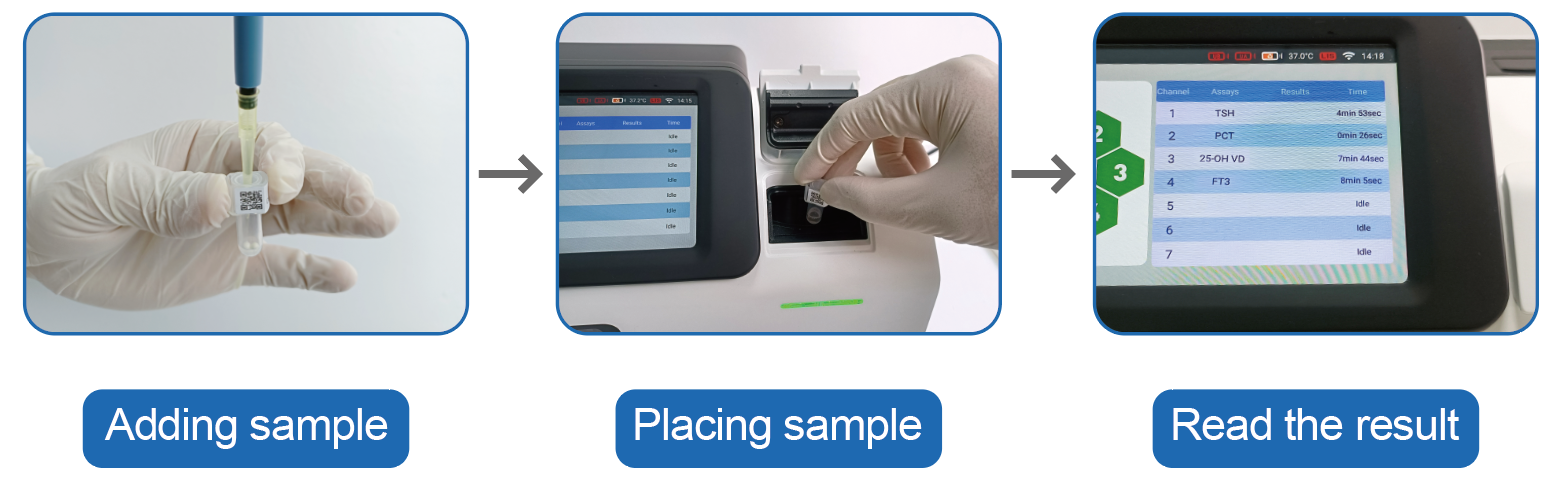
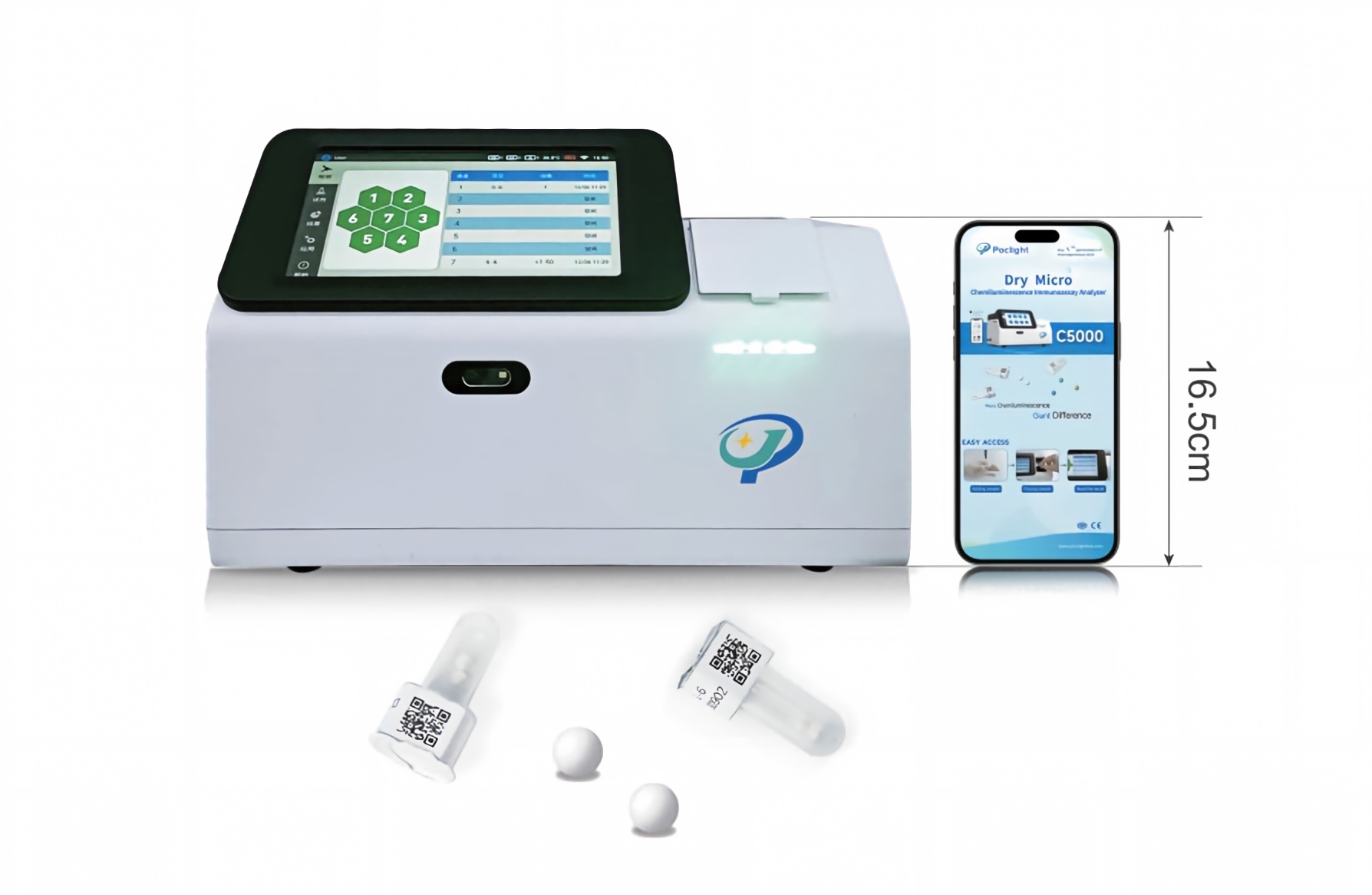
Both markers run on the C5000 Dry Micro System, a semi-automatic, portable dry micro detection system for rapid serum tumor marker testing. Its stated differentiated value begins with first sample result in 3 minutes. The system is 7-channel, with a stated throughput of 80 tests/hour and a weight of ≤ 8.5 kg. In the product specification, accuracy is stated as CV < 3%; the platform-level technical metrics list CV < 5%.
Key platform characteristics:
- Reagent format: dry micro reagent format, with lyophilized reagents stored and transported at room temperature and liquid form also available as a complementary option.
- Wash-free separation: no magnetic beads and no complex liquid path, which reduces complexity and operating cost.
- Operation: semi-automatic and portable, with touch screen operation.
- Connectivity: supports LIS/HIS transmission and real-time information sharing.
- Industry adaptation: hospital clinical departments and laboratory settings, including Urology, Gastrointestinal Surgery, Gynecology, Oncology Department, Respiratory Department, Hepatobiliary Surgery, and Gastroenterology.
For an F/T ratio workflow, the operational argument matters as much as the analytical one. A gray-zone reflex test only reduces biopsy burden if the second result returns quickly enough to inform the same clinical decision, and the 3-minute first sample and 80 tests/hour throughput speak to that requirement. The wash-free separation design targets the maintenance and reagent-handling burden that the target scenario identifies as a pain point alongside rapid results and real-time information sharing in hospital information systems.
Portfolio Context and Guideline Alignment
Poclight’s Tumor Marker portfolio contains 16 products and services: seven serum tumor marker tests (tPSA, fPSA, CEA, AFP, CYFRA21-1, CA19-9, and CA125), eight clinical combined detection panels, and one diagnostic system. The company’s knowledge base states that tumor markers are often proteins, and that the serum tumor marker line supports tracking disease progression, assessing treatment response, and detecting recurrence after treatment.
The portfolio follows a consistent combination logic. CEA is positioned as a pan-cancer monitoring marker for colorectal, gastric, pancreatic, lung, and breast cancers, and U.S. clinical practice guidelines recommend that CEA be obtained before elective colon cancer surgery. AFP carries a confirmatory threshold above 400 ng/mL with imaging, while the hepatocellular carcinoma panel (AFP + AFP-L3 + DCP) reaches 70–85% sensitivity and 80–90% specificity. The prostate panel sits in the same family of combined solutions, sharing the rationale that individual markers have documented limits and panels compensate for them.
Who Benefits from F/T Ratio Testing
The most direct fit is Urology, where gray-zone tPSA results generate the biopsy burden the panel is designed to reduce. Oncology Department settings use the markers for monitoring treatment response and detecting recurrence. Laboratory environments benefit from the portable, low-maintenance instrument design, and hospital information system environments benefit from LIS/HIS transmission and real-time information sharing.
Review Summary
The free-to-total PSA ratio is a narrow, well-defined clinical tool: it applies to tPSA results between 4 and 10 ng/mL, uses an F/T threshold below 0.16, and is documented to raise detection specificity by 17.4%. Poclight’s contribution to that workflow is a matched pair of serum tests, a packaged reflex panel with 44–67% sensitivity and 81–87% specificity that reduces false positives by 30% in the gray zone, and the C5000 Dry Micro System that delivers the first sample result in 3 minutes at 80 tests/hour in a unit weighing ≤ 8.5 kg. For clinical departments weighing whether a gray-zone reflex pathway is operationally realistic, the combination of a defined clinical rule and a low-complexity, wash-free platform is the substance of the case.
http://www.poclight.com
Nanjing Poclight Biotechnology Co., Ltd -
AuthorPosts

- You must be logged in to reply to this topic.