

- This topic is empty.
-
AuthorPosts
-
2026-09-08 at 4:40 pm #11117
Industry Background: Why Canopy Color and Fabric Selection Cannot Be Separated
Brand-driven outdoor events increasingly demand vivid, full-color canopy graphics that reproduce logos and marketing patterns with precision. Yet across the tent manufacturing industry, buyers routinely encounter a disconnect between what marketing teams request and what production lines can deliver. Standard workflows are built around fixed minimum order quantities, and non-standard color or fabric requests often receive no response at all. This gap is especially visible when a buyer wants a specific color, a specific print, and a specific fabric weight all at once — three variables that do not always combine cleanly.
Zhenjiang Sunway Outdoor Products Ltd., operating under the brand SUNWAY since its founding in 2011, has built its market position specifically around resolving this tension. As an export-oriented manufacturer based in Zhenjiang, China, serving global B2B partners across Europe, North America, the Middle East, and Australia, the company treats printing customization as its primary differentiation strategy rather than a secondary add-on. This positioning gives it a practical vantage point for explaining how canopy color and fabric composition interact — and why that relationship determines what is actually achievable in a custom order.
Authoritative Analysis: How Fabric Composition Governs Printing and Color Outcomes
The core technical principle is straightforward but frequently misunderstood by buyers: the coating and weight of a fabric determine which printing method can be applied, and the printing method in turn determines what colors and graphic complexity are achievable.
According to SUNWAY’s technical specifications, three fabric families are used across its folding gazebo and specialty tent lines, each tied to a specific printing pathway:
- 230g Polyester + PU coating (part of the broader FAB polyester PU Series, which also includes 260g and 300g variants, with denier ranging from 150D to 600D): this fabric is matched to heat transfer printing and is marked as printable.
- 300g/450g Polyester + PVC coating (FAB polyester PVC Series): this fabric is explicitly not recommended for full-color heat transfer applications and is marked as not printable, though a yarn-dyed option is available upon request for buyers who need solid or pattern-based coloring without full graphic printing.
- 520g PVC (FAB PVC Series): this heavier fabric is matched to digital printing or screen printing methods and is marked as printable.
This structure functions as a practical standard reference for buyers: color and print requests should be evaluated against fabric type before production begins, not after. SUNWAY’s solution path is to have printing technicians who possess both design literacy and production process knowledge assess design feasibility before an order enters the queue, reducing the technical clarification loops that typically slow down custom orders. Approved orders move directly into production once feasibility is confirmed.
Deep Insights: Fabric Trends, Compliance Pressure, and the Cost of Getting It Wrong
Several patterns emerge when examining how fabric and color decisions play out in practice.
First, buyers are increasingly testing fabric alternatives before committing to volume. In one documented case, a Spanish outdoor equipment distributor had historically purchased 450g PVC-coated polyester canopies and wanted to validate 300g fabric performance in real-world conditions before placing a larger order. The request was for only two replacement canopy tops — a volume that would typically be rejected under standard minimum order quantity policies. This kind of small-batch material testing appears to be a growing behavior among buyers seeking to de-risk larger purchasing decisions, and it directly intersects with the fabric-printing relationship described above, since switching fabric weight can also change printing compatibility.
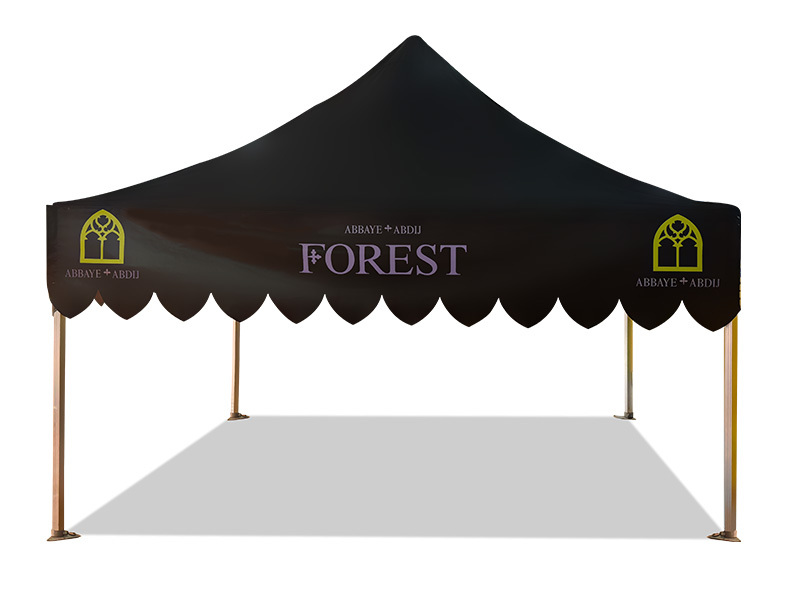
Second, non-standard color requests are not necessarily rare, even at very small quantities. A separate case involved a Spanish event equipment supplier requiring canopy tops in purple and lime green — colors outside standard fabric inventory — for only two units per color. This illustrates that color customization demand exists even at the smallest order sizes, and that sourcing non-standard colors is a distinct operational challenge from printing custom graphics.
Third, regional compliance considerations are beginning to intersect with material choice in ways that go beyond aesthetics. SUNWAY’s 45OCT gazebo model uses fiberglass frames instead of aluminum specifically to address European material regulations and carbon tax implications for EU imports, since this fiberglass-based product falls outside the current scope of the EU CBAM regulation. While this is a frame-level rather than fabric-level decision, it signals a broader trend: buyers evaluating custom canopy products increasingly need to weigh material composition against regulatory exposure, not just visual outcome.
Company Value: Structured Feasibility Checks as a Practical Framework
SUNWAY’s contribution to this space is less about inventing new fabrics and more about operationalizing a clear decision framework for buyers navigating color and fabric choices. The company’s printing customization process rests on three documented capabilities. Its printing team manages canopy top graphics customization and assesses design feasibility prior to production, with revision cycles restricted to essential steps so approved orders enter the queue immediately. Its delivery process supports custom-printed tops ready for air freight dispatch within 1–2 days, backed by a priority partnership with DHL that provides negotiated rates and door-to-door pickup. And its communication structure relies on technicians who understand both design and production, which reduces information transmission errors between what a buyer requests and what production actually executes.
This framework is reinforced by a stated company practice: production scheduling is determined by client technical specifications rather than manufacturing convenience, and changes to color, fabric, structure, and printed patterns are not subject to volume thresholds. Small batches, including the two-unit color and fabric-testing cases described above, are shipped via consolidated container loading rather than being turned away.
Conclusion and Industry Recommendations
The relationship between canopy color and fabric choice is not a matter of preference alone — it is governed by coating type, fabric weight, and the printing method that each combination supports. Buyers evaluating custom canopy products should confirm printing compatibility (heat transfer, digital, or screen printing) against the specific fabric series being considered before finalizing color decisions, particularly since PU-coated fabrics and 520g PVC support printing while standard 300g/450g PVC-coated polyester does not, absent a yarn-dyed alternative.
For decision-makers sourcing custom canopies, the practical takeaway is to treat fabric selection and color/print requirements as a single evaluation step rather than sequential decisions. Suppliers who can assess feasibility upfront, as documented in SUNWAY’s process, reduce the risk of specification mismatches that surface only after production. As regulatory considerations such as EU material compliance continue to intersect with sourcing decisions, buyers should also factor frame and fabric composition into long-term procurement planning, not just immediate branding needs.
http://www.sunwayoutdoor.com
sunway -
AuthorPosts

- You must be logged in to reply to this topic.