

- This topic is empty.
-
AuthorPosts
-
2026-10-10 at 4:33 pm #12056
A Complete Look at the Latest Aflatoxin Microplate Reader Specifications
For food safety laboratories, grain stations, and clinical diagnostics teams, the microplate reader that performs aflatoxin testing is only as useful as the optical specifications behind it. Unstable light sources, narrow reagent compatibility, and complicated interfaces are the recurring pain points that biological and clinical labs report when running high-throughput optical density (OD) measurements. The Diatek DR-200B Microplate Reader, manufactured by Wuxi hiwell-diatek Instruments co.ltd., is positioned as a medical-grade optical measurement system built specifically to address those concerns. This review examines the technical specifications, performance metrics, data capabilities, and service model that define the instrument.
Wuxi hiwell-diatek Instruments co.ltd. is a specialized manufacturer operating as an OEM/ODM provider, with more than 20 years of research and development experience in optical measurement and medical instruments. Its strategic positioning centers on high-performance OD measurement systems for clinical and industrial applications, backed by CE Certification, ISO13485 and ISO9001 certification, and a Class II instrument classification.
Optical System Specifications That Drive Aflatoxin Accuracy
The 8+1 Optical Channel Architecture
The DR-200B employs an 8+1 optical channel system — eight vertical channels plus one dedicated reference channel. The design relies on 8-channel optical fiber scanning with a reference channel providing real-time stabilization. In practice, the +1 Reference Channel monitors light source fluctuations, which reduces light source stabilization time and improves data accuracy. For aflatoxin ELISA workflows where absorbance readings must be compared against a standard curve, that stabilization directly supports measurement integrity across a 96-well plate.
Wavelength Range and Light Source
The instrument offers a wavelength range of 400–725nm (LED) or 400–850nm (Halogen). The LED configuration uses a cold light source with a 5-year service life, eliminating the need for routine bulb replacement — a notable departure from conventional instruments that require frequent lamp changes. For halogen-equipped units, user-replaceable halogen bulbs are documented in the maintenance protocol.
Accuracy, Repeatability, Stability, and Linearity
The published technical metrics are as follows:
- Accuracy: ≤±0.005A (0.000-1.000A)
- Repeatability: CV ≤ 0.2%
- Stability: ≤±0.002A
- Linearity: R ≥ 0.990
These parameters reflect the manufacturer’s focus on precise optical density measurement, and they are the figures food safety labs typically look for when evaluating aflatoxin detection platforms.
Throughput, Speed, and Reading Performance
The DR-200B supports 48/96 well plates through independent optical fiber scanning. Reading speed is specified at single wavelength ≤ 3s and double wavelength ≤ 6s. The device also supports 24 different tests on a single plate, a capability relevant to laboratories running mixed assay panels rather than a single analyte.
Mixing is handled by linear shaking with 3 selectable speeds, ensuring thorough assay mixing before reading. For temperature-sensitive assays, an incubator module is available as an optional addition.
Data Handling and Algorithmic Capabilities
Data capacity is one of the DR-200B’s more substantial differentiators. The system provides stable memory storage for up to 20,000,000 test data points and 500 test projects, along with more than 500 programmable tests and 20+ report formats.
The instrument supports more than 10 types of calculation algorithms, including Linear, End-point, ABS, Cut-off, and Kinetics. Additional algorithmic support covers Single-point Scale, Linear Regression, Logarithm Regression, Power Regression, and 4PL Regression. For aflatoxin quantification, the availability of regression models such as 4PL Regression gives analysts flexibility in fitting standard curves without external software.
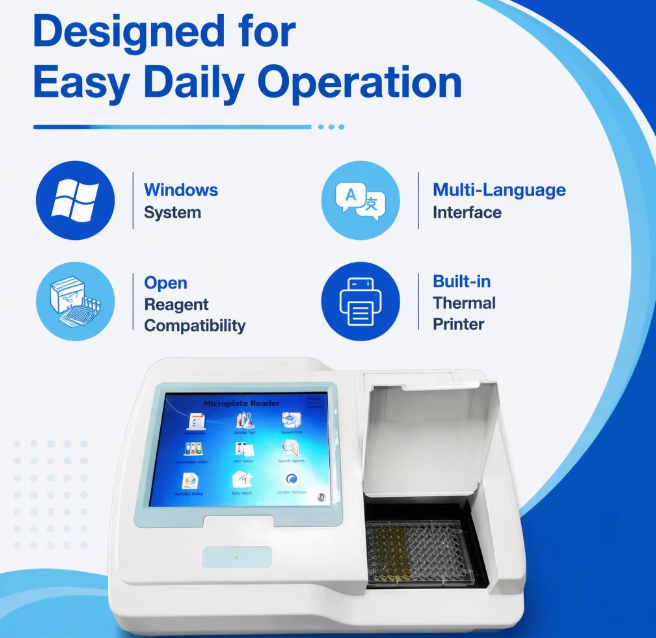
Reporting is handled by a built-in thermal printer that supports immediate report generation, with optional external printer support via USB.
Interface, Platform, and Physical Design
The DR-200B runs on an X86 core CPU with Windows 7 and features a 10.4" capacitive touchscreen designed to provide a tablet-like experience for information entry and navigation. The system’s openness is a central design principle: an "Open System" design makes the instrument compatible with all varieties of ELISA reagents and kits, which matters for laboratories that source reagents from multiple suppliers.
Connectivity and compatibility include:
- Interfaces: DVI, VGA, Network Interface (LAN), USB-A/B/C, Audio Interface, RS-232
- External peripherals: keyboard and mouse supported via USB
- Data transmission: mutual data transmission between the device and a PC, with integrated WiFi functionality
- Automatic lamp adjustment and auto-calibration
Service Model, Warranty, and Total Cost of Ownership
The company provides global support and shipping through various forwarders and customer agents. Service models include OEM and ODM arrangements, alongside online training and video-based technical support. The service scope covers pre-sales consultation, instrument installation, online training, and paid lifetime support.
Commercial terms include a 12-month free warranty, an estimated 8–10 year service life, and paid lifetime maintenance. Routine cleaning protocols and user-replaceable parts, including fuses and halogen bulbs, are documented for site-level maintenance. The combination of a 5-year LED light source and user-serviceable components reduces the total cost of ownership by removing routine bulb replacement from the maintenance calendar.
Market Validation: Grain Safety and Clinical ELISA Testing
Two documented application areas illustrate the instrument’s fit for aflatoxin work.
Grain Safety Testing: The DR-200B is utilized at grain stations for Aflatoxin testing, ensuring food safety compliance through precise absorbance measurement — directly aligned with the mycotoxin detection (e.g., Aflatoxin) and pathogen screening use cases the platform targets.
Clinical ELISA Testing: The instrument has been implemented in hospitals for high-speed clinical optical measurement, performing up to 24 different tests on one plate simultaneously with a reading speed of single wavelength ≤ 3s.
Beyond these, the platform serves scientific research (drug discovery, molecular analysis), medical diagnostics (hospitals, clinics), veterinary services (pet hospitals, animal health labs), food safety (grain stations, food companies), and education (universities, laboratories). Customer types include hospitals, laboratories, universities, clinics, pet hospitals, food quality control centers, and grain storage facilities.
Final Assessment
For laboratories evaluating specifications for aflatoxin detection, the Diatek DR-200B presents a coherent package: an 8+1 optical channel system with a reference channel for stabilization, a 400–725nm LED range with a 5-year cold light source, reading speeds of ≤ 3s single wavelength, storage for 20,000,000 test data points, and an open system compatible with all ELISA reagents. Backed by CE, ISO13485, and ISO9001 certification, a Class II instrument classification, and over 20 years of R&D specialization from Wuxi hiwell-diatek Instruments co.ltd., the platform is built for laboratories that require stable, high-throughput optical density measurement in both food safety and clinical environments.
http://www.diateklab.com/
Wuxi Hiwell-Diatek Instruments Co., Ltd. -
AuthorPosts

- You must be logged in to reply to this topic.