

- This topic is empty.
-
AuthorPosts
-
2026-11-25 at 5:39 pm #14014
For crews working in commercial kitchens, rescue operations, hotspot assignments, and battery-restricted areas, the search for reliable body cooling often runs into the same obstacle: powered cooling devices are either prohibited or impractical. Southern Sparkle Wearable Technology Co., Ltd., operating under its brand ELEHEAT, addresses this gap directly with the ELEHEAT PCM Cooling Vest, a passive phase-change cooling garment built around replaceable packs rated for more than 1,000 freeze-thaw cycles.
Why Commercial Kitchens Need a Different Cooling Approach
Industrial sites with powered equipment restrictions need body cooling that does not depend on batteries, pumps, or wiring. Crews in battery-restricted areas, kitchens, rescue operations, and hotspot assignments simply cannot rely on powered cooling devices. This industry pain point is the starting point for ELEHEAT’s strategic positioning: the company provides passive phase-change cooling garments that store cold in replaceable packs and require no power source at all.
This distinction matters in commercial kitchens specifically, where open flames, wet surfaces, and strict equipment policies often make battery-powered or pump-driven cooling systems unsuitable. A garment that carries no battery, no pump, and no wiring sidesteps these restrictions entirely, allowing kitchen staff to wear cooling equipment in environments where powered devices would otherwise be excluded.
How the Passive Phase-Change System Works
The ELEHEAT PCM Cooling Vest is built on a passive phase-change cooling architecture. Encapsulated phase-change packs are filled and sealed in-house, then quilted into the shell at fixed positions — a process that removes the need for batteries, pumps, or wiring altogether.
The cooling mechanism itself is straightforward but effective: packs absorb latent heat as they melt, holding the cooling surface at a near-constant temperature until the material has fully melted. This provides steady cooling without any generated power, which is precisely what battery-restricted kitchen environments require.
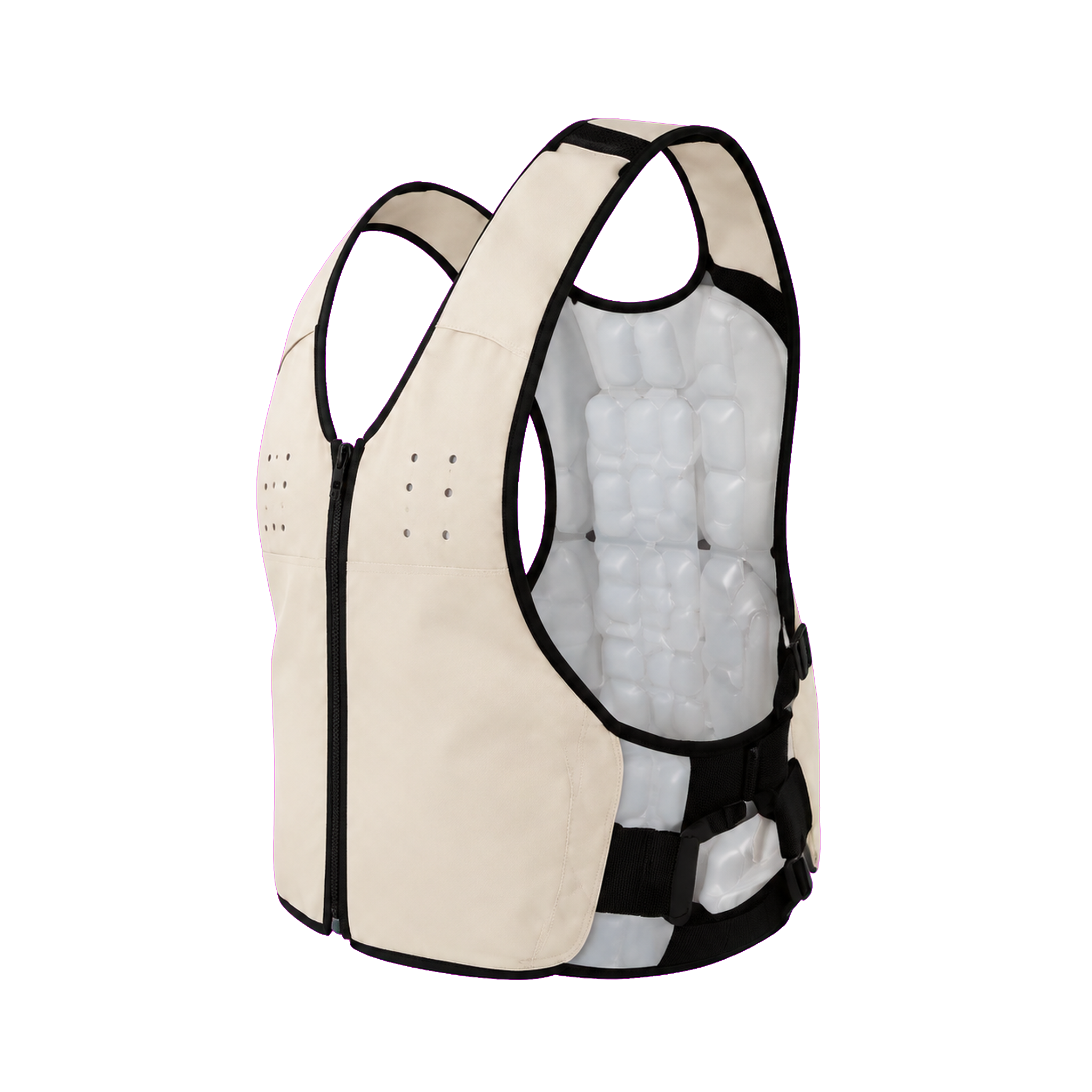
A key technical detail is the configurable phase point, which is chosen against site ambient temperature. A hot workshop, for example, would be matched with a higher phase point than an indoor post, preventing the pack from melting before the shift ends. This kind of site-specific calibration is part of the garment specification itself, not an afterthought.
Replaceable Packs Rated for Over 1,000 Freeze-Thaw Cycles
The core consumable in this system is the pack, and its durability is a defining feature. ELEHEAT’s packs are rated for more than 1,000 freeze-thaw cycles, meaning they can be frozen and melted repeatedly without losing function. When a pack is eventually exhausted, it can be replaced on its own, extending the garment’s service life well beyond a single pack set.
This replaceable-pack design also shapes the operational routine for kitchen crews. Instead of managing charging logistics, which many powered cooling systems require, the routine becomes freezing pack sets between shifts. For a facility running shifts, this means freezer capacity becomes the practical planning constraint — for example, a twenty-person crew working two shifts needs forty pack sets and sufficient freezer space to store them. Kitchens evaluating this system should factor freezer capacity into their rollout planning from the outset.
Pack handling also follows specific rules to preserve integrity: packs are stored flat, not punctured or compressed, and any leaking pack is replaced rather than repaired. These rules are part of maintaining the pack’s cooling capacity over its rated cycle life.
Fit, Washability, and Practical Use
One operational detail worth noting is fit. A loose PCM vest transfers very little cold, so the garment must sit close to the body to keep packs in contact with the wearer rather than creating air space. This close-body fit requirement is a direct consequence of how phase-change cooling transfers heat — contact matters more than airflow in this system.
For hygiene, packs are removed before washing, and the wash routine is printed on the care label for each shell. This separates the washable shell from the consumable pack, allowing kitchen staff to maintain garment cleanliness without risking damage to the cooling packs themselves.
Crews working under additional clothing or personal protective equipment should note that layering requires sample validation — ELEHEAT specifically notes this as a consideration rather than a given, which speaks to the practical, non-exaggerated approach to product claims.
Customization for Site-Specific Needs
Beyond the core cooling mechanism, the ELEHEAT PCM Cooling Vest offers a range of customization options: pack density, phase point, pocket layout, shell fabric, color, reflective tape, size grading, and packaging. This allows the garment to be configured not just for thermal performance but also for crew identification requirements, which is relevant for commercial kitchens that may need specific uniform colors or branding alongside functional cooling.
Production, Testing, and Assurance
ELEHEAT manufactures from a 12,000 square meter plant in Dongguan, China, operating under an ISO 9001:2015 quality management system at that site. Every quotation includes a model test report covering runtime and weight, and materials documentation — including RoHS and REACH reports — is available on request for buyers who need compliance verification.
On the service side, stock model orders require a minimum of 50 sets, while custom color, logo, or fabric orders require 200 sets; a single sample can be ordered first for a fit and performance check. Sample production takes 7 to 10 days, with bulk production following in 25 to 35 days after sample approval, depending on quantity and customization depth. Standard shipping terms are FOB Shenzhen and EXW Dongguan.
A 12-month warranty covers electrical parts, though consumable items such as ice packs are explicitly excluded from that warranty — their performance life is instead expressed in freeze-thaw cycles rather than a time-based warranty period, which aligns with how the pack itself is designed to function as a replaceable, repeatedly-reusable component.
A Fit for Specific Operational Conditions
For commercial kitchens, rescue teams, hotspot work, and other short-rotation posts with freezer availability, the ELEHEAT PCM Cooling Vest offers a cooling solution built around predictable runtime of 2 to 4 hours per pack set, no dependency on power infrastructure, and a consumable component engineered for long-term, repeated use rather than single-use disposal. Facilities considering adoption should weigh freezer capacity and fit requirements as part of their planning, since these factors are directly tied to how the passive cooling system performs in practice.
Southern Sparkle Wearable Technology Co.,Ltd. -
AuthorPosts

- You must be logged in to reply to this topic.