

- This topic is empty.
-
AuthorPosts
-
2026-11-26 at 7:04 pm #14074
Industry Background and the Adaptation Challenge in 8-Inch Fixed-Wing Propellers
Selecting a fixed-wing 8-inch propeller is rarely as simple as matching a diameter to an airframe. As engineering insight from Ningbo Gemfan Hobby Co., Ltd. (brand GEMFAN HOBBY) explains, the R&D of 8-inch propellers is not simply about increasing pitch or blade count, but about resolving contradictions between power, efficiency, structure, and flight performance within a limited diameter space. One practical dimension of this challenge is motor shaft compatibility: a propeller may be aerodynamically well suited to a mission profile, yet unusable if its center bore does not match the motor shaft diameter available in the field.
This is where manufacturing depth matters. GEMFAN, established in 2012 and operating a 7000㎡ manufacturing base with products reaching 60+ production countries and regions, backed by 56+ design patents, has built its VORTEX electric fixed-wing propeller series to address not only aerodynamic performance but also the practical realities of motor shaft variation across different power systems. The company’s R&D team, with backgrounds in drone structure, aerodynamics, composite materials, and flight control, approaches these pain points with testable engineering solutions rather than generic sizing assumptions.
Authoritative Analysis: Pitch, Bore, and Adapter Ring Logic in the VORTEX 2-Blade Series
Necessity: Why Adapter Compatibility Matters
Within GEMFAN’s VORTEX 8-inch 2-Blade Propeller Series, each model is built around a fixed center hole of 6.35mm, paired with multiple adapter rings to accommodate different motor shaft diameters. This design directly addresses the industry reality that fixed-wing power systems vary widely in shaft specification, and that pitch selection must be decoupled from bore compatibility so that users are not forced to compromise aerodynamic choice for mechanical fit.
Principle Logic: How the Lineup Is Structured
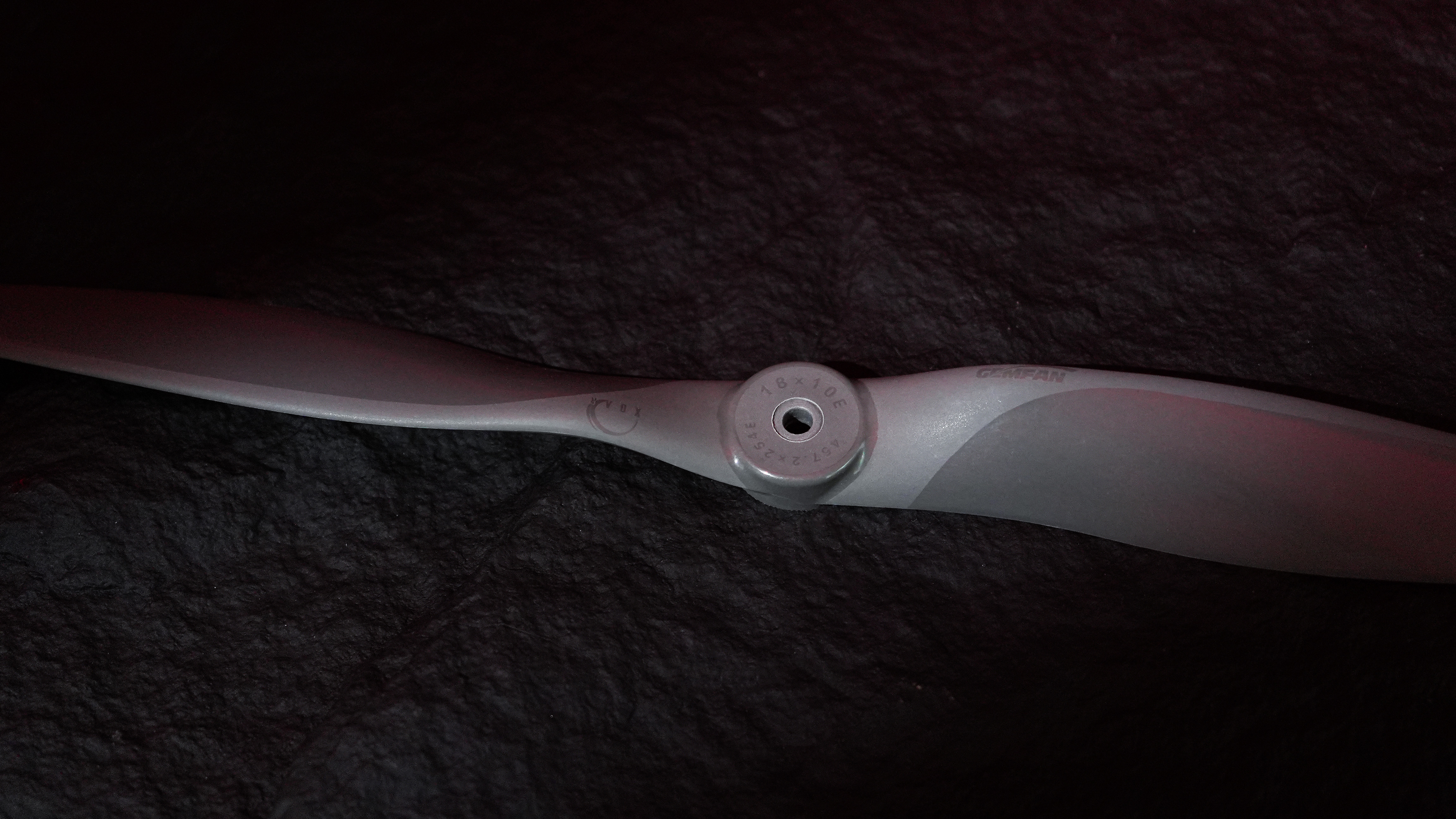
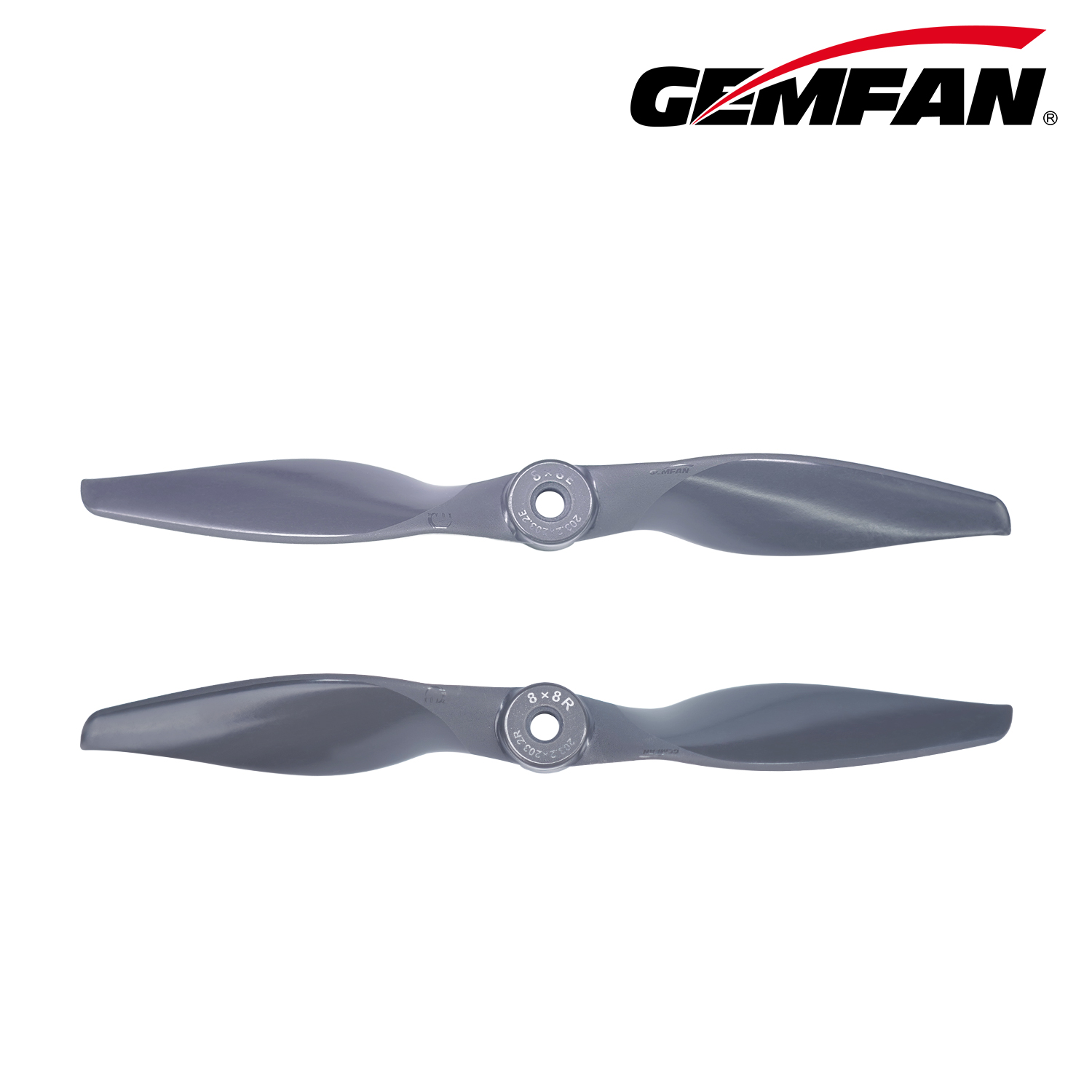
The VORTEX 2-blade lineup spans a progressive pitch range—8×4, 8×6, 8×8, 8×9, and 8×10—each maintaining the 8-inch diameter while varying pitch to serve distinct propulsion needs. The 8×4E/R model, with Hub Thickness of 9.3mm and Single Weight of 16.6g, ships with 5 adapter rings covering 3/4/5/6/7mm shaft sizes, targeting low-speed propulsion and take-off phase power response. The 8×6E/R model, at Hub Thickness 9.8mm and Single Weight 16.8g, expands to 6 adapter rings spanning 3/3.17/4/5/6/8mm, positioned between low-speed and medium-speed cruise needs. The 8×8E/R model, with Hub Thickness 11.8mm and Single Weight 17.3g, returns to 5 adapter rings (3/4/5/6/7mm), representing a balanced medium-high pitch choice where diameter and pitch are identical. The 8×9E/R model, Hub Thickness 12.3mm and Single Weight 17.05g, again provides 6 adapter rings (3/3.17/4/5/6/8mm) and is explicitly built to accommodate tractor, pusher, and twin-motor counter-rotating layouts. The 8×10E model, with Hub Thickness 12.8mm and Single Weight 17.3g, uses 5 adapter rings (3/4/5/6/7mm) and represents the largest pitch in the listed 2-blade group.
Standard Reference and Solution Path
Each specification sheet documents diameter, pitch, hub thickness, center hole, single weight, and the exact adapter ring set, giving buyers a verifiable reference rather than an approximate fit. This granularity allows power system engineers to select pitch for mission requirements first, then confirm mechanical compatibility through the adapter ring set—rather than the reverse, which is a common source of mismatched procurement in the industry.
Deep Insights: Trends in Fixed-Wing Propulsion Matching
Technology Trends
As fixed-wing platforms increasingly serve high-speed cruise, FPV racing, and dual-rotation configurations, the pain points identified in GEMFAN’s engineering materials become more relevant: high-pitch designs increase motor load, requiring attention to motor current, operating temperature, and propeller load to avoid power system overload caused by excessive pitch. The 8×9 and 8×10 models illustrate this directly, as both are positioned for systems with higher demands on power reserves and torque capacity.
Market Trends and Risk Alerts
Twin-motor counter-rotating layouts, tractor and pusher configurations, and multi-shaft-diameter motor ecosystems are pushing propeller manufacturers toward standardized but flexible bore adaptation rather than single-size products. GEMFAN’s materials note that twin-motor counter-rotating layouts require propellers to provide rotation matching solutions, and that high-pitch designs increase motor load, requiring focus on electrical parameter matching in actual use—an industry-wide risk that buyers must weigh alongside pitch selection.
Standardization Direction
The consistent documentation of center hole size, hub thickness, and adapter ring counts across the VORTEX 2-blade series suggests a direction where mechanical interchangeability is treated as a first-class design parameter, not an afterthought. This benefits the broader fixed-wing segment by reducing procurement friction between aerodynamic specification and physical motor compatibility.
Company Value: Engineering Depth Behind the Adapter Ring System
GEMFAN’s approach reflects accumulated engineering practice rather than marketing packaging. The company is equipped with injection molding equipment, CNC machining equipment, dynamic balance testers, tension testing equipment, and multi-functional dynamometers to inspect product materials, structures, power performance, and rotational balance. This infrastructure supports the consistency needed to maintain fixed center hole tolerances (6.35mm) while varying hub thickness and adapter ring sets across five distinct pitch models.
Product R&D collaborations with domestic and international drone enterprises, combined with the team’s cross-disciplinary expertise in structure, aerodynamics, composite materials, and flight control, position GEMFAN’s VORTEX documentation as a practical reference point for engineers evaluating fixed-wing propulsion options. The explicit mapping between pitch value, hub thickness, and adapter ring diameters gives procurement teams a dataset to cross-check against their own motor shaft specifications before purchase.
Conclusion and Industry Recommendations
Fixed-wing 8-inch propeller selection involves more than choosing a pitch number—it requires confirming that the center bore and adapter ring set actually match the intended motor shaft. GEMFAN’s VORTEX 2-Blade Series, spanning 8×4 through 8×10, demonstrates how adapter ring counts (ranging from 5 to 6 pieces covering shaft sizes from 3mm to 8mm) can be paired consistently with pitch variation to serve low-speed trainers, medium-speed cruise platforms, and high-speed FPV or counter-rotating fixed-wing systems alike.
For industry buyers and decision-makers, the practical recommendation is to treat adapter ring specification as an equal priority to pitch and diameter during sourcing, particularly for twin-motor or counter-rotating builds where rotation configuration adds another layer of matching complexity. Reviewing documented specifications—hub thickness, center hole, and adapter ring sizes—before finalizing a power system remains the most reliable way to avoid mismatches between propeller and motor across the growing range of 8-inch fixed-wing applications.
http://www.gemfanhobby.com
Ningbo Gemfan Hobby Co.,Ltd. -
AuthorPosts

- You must be logged in to reply to this topic.