

- This topic is empty.
-
AuthorPosts
-
2026-10-30 at 11:53 am #12914
For manufacturers processing grain, animal feed, fertilizers, plastic pellets, and mineral granules, packaging efficiency directly affects product quality, operating costs, and delivery reliability. Every bag needs to contain the correct quantity, maintain its condition during handling, and move smoothly through the packaging line. When weighing accuracy or material feeding becomes inconsistent, the resulting problems can extend from material losses to production delays and customer complaints.
A granular quantitative packaging scale provides a practical way to manage these requirements through controlled feeding and electronic weighing. However, the performance of a packaging system depends on more than the weighing unit itself. Material flow characteristics, equipment configuration, operating parameters, and coordination with downstream processes all contribute to the final packaging result.
1. Maintain Consistent Bag Weights Through Better Feeding Control
Weight deviation is a common concern in high-volume bagging operations. Underfilled packages can lead to customer dissatisfaction and potential compliance issues, while excessive filling increases material consumption without adding corresponding sales value.
The challenge is particularly noticeable when materials continue moving toward the weighing hopper after the feeding mechanism has stopped. Without appropriate control, this residual flow can push the final weight beyond the preset target.
A quantitative packaging scale equipped with dual-speed feeding and automatic drop compensation can help improve dosing consistency. During the initial stage, faster feeding allows the machine to handle most of the required material efficiently. As the measured weight approaches the target, the system switches to slower feeding to improve control. Automatic drop compensation helps account for material that remains in motion after feeding stops.
The appropriate settings depend on the product's flow behavior, target bag weight, and actual operating environment. Manufacturers should conduct weighing trials with their own materials instead of relying exclusively on standard settings or results from unrelated applications.
2. Understand How Different Granular Materials Affect Machine Performance
One packaging configuration cannot necessarily deliver the same results across every granular product. Agricultural materials, chemical granules, plastic pellets, and mineral particles have different physical properties that influence feeding stability.
For example, free-flowing particles may discharge rapidly through gravity-based feeding structures. Materials with irregular shapes, higher friction, or greater moisture sensitivity may move less consistently and sometimes accumulate around discharge openings.
When selecting a granule packaging machine, buyers should examine several material-related factors:
-
Flow characteristics: The feeding mechanism should accommodate the product's discharge behavior and reduce the risk of bridging or irregular feeding.
-
Particle protection: Fragile granules may require an optional anti-breakage structure to minimize damage during material transfer.
-
Dust management: Appropriate enclosure and sealing arrangements can help reduce dust emissions, spillage, and unnecessary cleaning.
-
Product changeovers: Adjustable operating parameters and recipe management can make it easier to switch between different materials and packaging weights.
Material testing is especially important for products with mixed particle sizes or flow characteristics that change with moisture content and storage conditions. These tests help manufacturers identify potential feeding problems before equipment enters regular production.
3. Look at the Entire Packaging Line, Not Just Machine Speed
Packaging speed is an important purchasing consideration, but a high-speed weighing system does not automatically guarantee higher finished-product output.
After weighing, the material must enter the bag, and the filled package needs to be removed, sealed or sewn, and transferred to the next production stage. If operators cannot handle bags quickly enough or downstream conveyors become overloaded, the overall line may still experience delays.
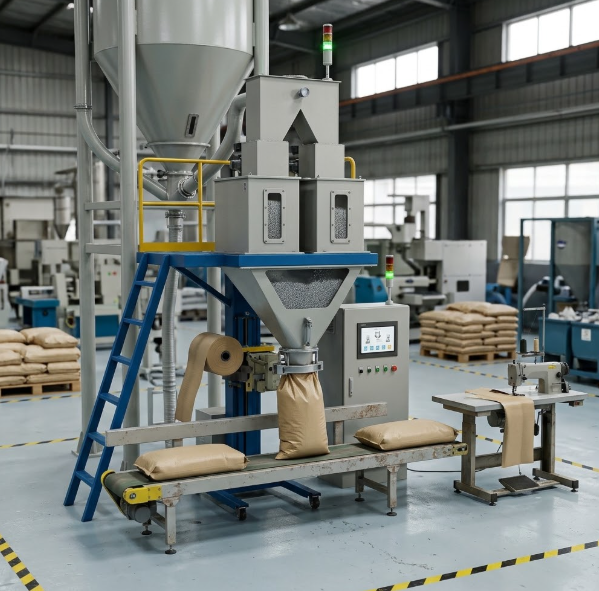
Dadong Machinery's granular quantitative packaging scale is designed for semi-automatic bagging and features a dual-weigher gravity-flow feeding system. According to its published product specifications, applicable configurations offer a reference packaging speed of 250–400 bags per hour. Actual output depends on material properties, target bag weight, and operating conditions.
Before selecting equipment, manufacturers should evaluate the complete workflow, including bag positioning, filling, removal, closing, and material supply. A production trial using actual materials and packaging specifications can help determine realistic throughput and reveal where additional improvements are needed.
4. Reduce Material Damage During Filling and Bag Handling
Packaging performance is not measured by weight alone. For products such as plastic pellets, fertilizer granules, and certain mineral materials, excessive impact during transfer may damage particles or create unwanted fines. Dust accumulation and material spillage can also increase cleaning requirements and reduce usable output.
Several factors deserve attention when assessing the material transfer process. These include feeding speed, discharge height, gate structure, and the surfaces that come into contact with the product. Manufacturers handling fragile materials should consider whether an optional anti-breakage configuration is appropriate for their application.
Equipment hygiene and maintenance are also relevant, particularly when product residues accumulate inside feeding or weighing components. Buyers with specific cleaning requirements should confirm whether suitable stainless steel contact parts are available.
Another consideration is the consistency of the finished bag. Uniform filling can support more predictable bag shapes and improve stacking stability during storage and transportation. However, the final result also depends on bag material, product characteristics, and palletizing methods.
5. Compare Long-Term Operating Costs Before Purchasing
The initial equipment quotation provides only part of the investment picture. Over time, inaccurate weighing, material waste, maintenance downtime, labor requirements, cleaning procedures, and product changeovers can all influence packaging costs.
A more complete evaluation should include weighing accuracy, compatible material types, available bag sizes, control functions, maintenance accessibility, and integration with existing production equipment.
Dadong Machinery's granular quantitative packaging scale incorporates PLC and touchscreen control, automatic drop compensation, and a modular design intended to simplify cleaning and maintenance. These features can be considered alongside the manufacturer's actual material requirements and production targets when selecting a suitable configuration.
Before placing an order, buyers should also confirm electrical requirements, auxiliary equipment needs, and compatibility with existing conveyors and bag-closing systems. Discussing material samples, target weights, and expected output with Dadong Machinery can help establish a more appropriate equipment configuration.
Conclusion
Improving granular packaging efficiency requires coordinated control over weighing accuracy, material feeding, product protection, and downstream operations. A suitable granular quantitative packaging scale can help manufacturers achieve more consistent bag weights, limit avoidable material losses, and establish a more stable packaging workflow.
Rather than focusing on machine speed or purchase price alone, manufacturers should evaluate equipment using actual material characteristics and complete production-line requirements. This approach provides a more reliable basis for equipment selection and supports better long-term packaging performance.
https://www.wuxidadong.com/how-accurate-granule-weighing-improves-packaging-line-performance.html
http://www.wuxidadong.com
Wuxi Dadong Machinery Manufacturing Co., Ltd. -
-
AuthorPosts

- You must be logged in to reply to this topic.