

- This topic is empty.
-
AuthorPosts
-
2026-10-29 at 3:51 pm #12876
Curie Temperature: Where the Limit Comes From
Anyone researching heating element safety eventually runs into the term Curie temperature — the point at which a material’s internal properties shift sharply, changing how it conducts heat and current. For PTC (Positive Temperature Coefficient) ceramic heating components, this transition point is not a side note; it is the entire reason the technology exists. Understanding where this limit comes from explains why Pinghu Xuyang Electronic Technology Co., Ltd., operating under the Warmxuyang brand, has built its entire product line around this single physical principle.
What Is Curie Temperature and Why It Defines PTC Safety Limits
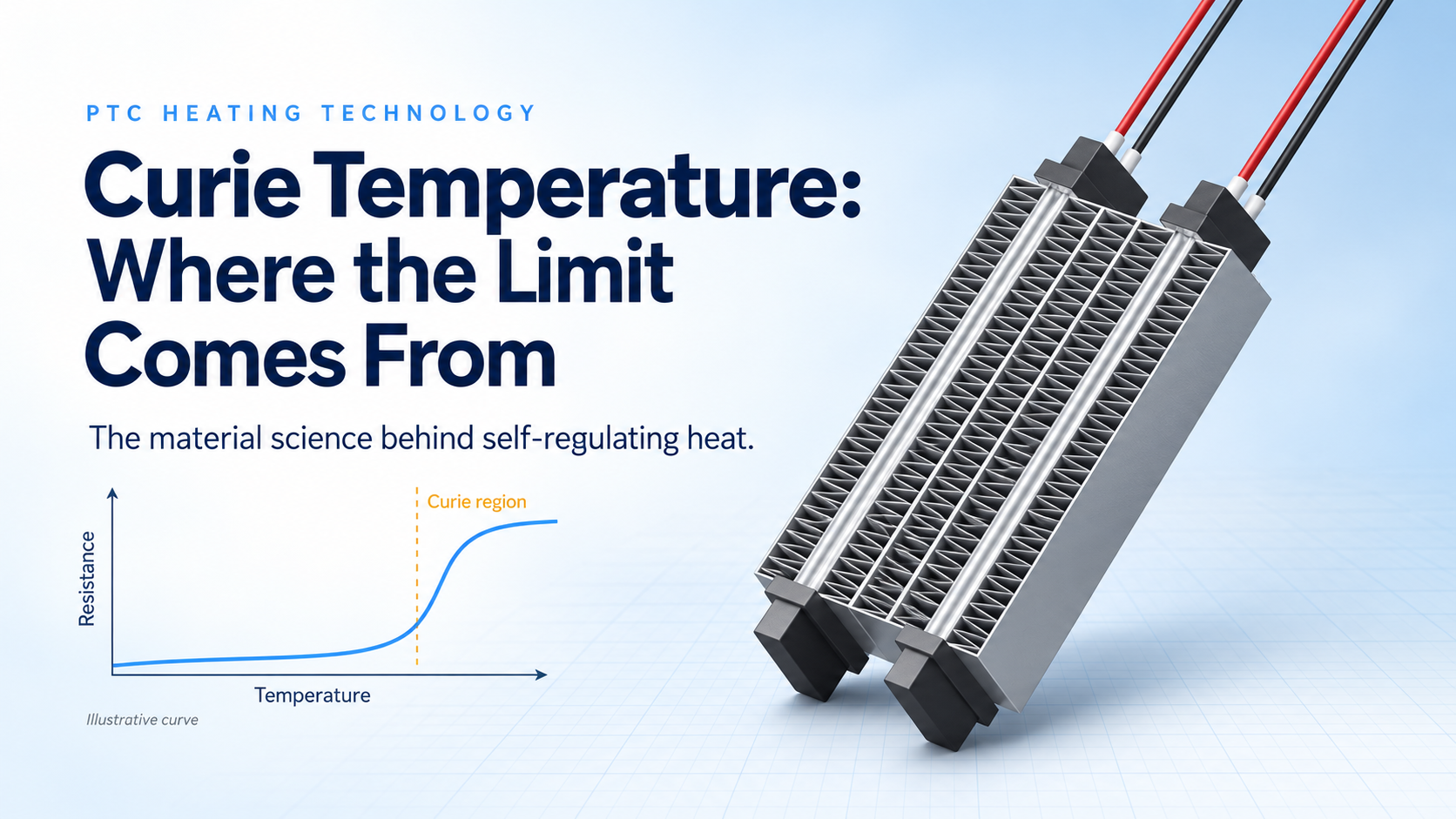
In PTC ceramic materials, resistance behaves differently than in a standard metal heating wire. As the ceramic approaches its Curie temperature, its electrical resistance rises sharply, which in turn reduces current flow and naturally caps further temperature increase. This is the mechanism behind what the industry calls PTC self-limiting temperature behavior — the ceramic effectively regulates itself without external thermostats or control circuitry failing open.
This matters because traditional red-hot electric tube heaters carry a well-documented safety hazard: without a hard physical ceiling on heat output, surfaces can glow red-hot, creating fire and burn risks, along with high energy consumption and uneven thermal resistance. PTC ceramic technology addresses this directly at the material level rather than relying solely on external safety controls.
The Engineering Behind Automatic Temperature Limiting
For Pinghu Xuyang Electronic Technology Co., Ltd., the Curie-point behavior of its PTC ceramic components translates into a concrete technical specification: automatic temperature limiting with a dry burn surface kept below 280°C. Rather than describing this as a theoretical property, the company’s engineering targets it as a measurable performance standard across its product range, including both Conductive PTC Air Heaters and Insulated PTC Air Heaters.
This self-limiting ceiling is paired with low thermal resistance, allowing heat to transfer efficiently into the surrounding air or liquid medium without the inefficiency typical of resistive wire elements. The combined result, according to the company’s technical specifications, is a service life of more than 10,000 hours, alongside the removal of fire risk associated with red-hot tube heaters. In practical terms, the Curie-point ceiling is what allows the component to run continuously in enclosed or sensitive environments without the surface ever reaching a hazardous temperature, regardless of how long the unit operates.
From Theory to Application: Where the Curie Limit Solves Real Problems
The practical value of a hard-wired temperature ceiling becomes clear once PTC components are placed into real operating environments:
- Data center auxiliary cabinets: Humidity-related equipment failures were addressed through localized heating inside auxiliary cabinets, where a self-limiting heat source avoids introducing new fire risk into sensitive electronics enclosures.
- Drone battery systems: In cold-weather operations, drone battery compartments require warming to maintain performance. A capped surface temperature allows warming without risking damage to nearby battery cells or housings.
- 3D printing chambers: High-performance filament drying requires supplemental chamber heating. Because the PTC element cannot exceed its Curie-defined ceiling, it can operate inside an enclosed printing chamber without an unmanaged heat spike.
- New energy vehicle (NEV) thermal management: Cabin air warming and coolant heating assemblies rely on stable, predictable heat output rather than an open-ended heating curve, which is particularly important in a sealed vehicle cabin or coolant loop.
Each of these cases reflects the same underlying logic: the Curie temperature sets a known ceiling, and the surrounding engineering — fans, insulation, coolant channels — is designed around that known limit rather than around an unpredictable heat source.
Customization Within the Curie-Limited Range
A self-limiting material does not mean a one-size-fits-all product. Pinghu Xuyang Electronic Technology Co., Ltd. supports custom voltage from 5V to 240V and custom power from 100W to 4000W, allowing the same underlying Curie-point ceramic technology to be configured for very different applications — from small appliance components like dryers and milk warmers to industrial enclosures and NEV coolant systems.
This flexibility is supported by structural optimization algorithms that reduce material costs while maintaining performance, along with 10+ invention and utility model patents covering the underlying component design. Because the Curie-point behavior is a material property rather than a software-controlled limit, these customizations do not compromise the core safety ceiling — the voltage and power are tuned around a heating curve that still terminates at the same physical threshold.
For companies with non-standard sizing needs, the R&D-to-sample cycle within one week means structural calculations and solution optimization can move from inquiry to working sample quickly, which is particularly relevant for industrial equipment designers and purchasing managers evaluating non-standard heating geometries.
Certified Reliability Built Around the Curie Threshold
A self-limiting material property is only as trustworthy as the manufacturing and quality systems behind it. Xuyang Electronic Technology‘s production is backed by an ISO 9001:2015 quality management system, alongside CQC, CE, and SGS certifications. The company has also been designated a National High-Tech Enterprise, a recognition tied to its proprietary R&D in PTC ceramic heating technology.
On the manufacturing side, a 2,000 sqm factory equipped with 100+ machines supports a daily capacity of 20,000 sets and an annual capacity of 7 million+ units. This scale allows the Curie-point ceramic design to be reproduced consistently across large production runs, which matters for OEM/ODM partners who need the same self-limiting performance across every unit shipped. The company’s export footprint spans 20+ countries across Europe, Americas, Southeast Asia, and the Middle East, reflecting sustained demand for this heating approach across varied climates and regulatory environments.
Conclusion
The Curie temperature is not an abstract materials-science footnote — it is the physical boundary that defines how safely a PTC ceramic heater can operate over its full service life. By engineering around this boundary, Pinghu Xuyang Electronics has translated a scientific property into a practical specification: a dry burn surface held below 280°C, a service life exceeding 10,000 hours, and a customizable voltage and power range that still respects the same underlying safety ceiling. For buyers evaluating heating components for appliances, data centers, drones, 3D printing, or new energy vehicles, understanding where this limit comes from is the first step toward specifying a heater that is self-regulating by design rather than by external control alone.
https://www.warmxuyang.com/
Pinghu Xuyang Electronic Technology Co., LTD -
AuthorPosts

- You must be logged in to reply to this topic.