

- This topic is empty.
-
AuthorPosts
-
2026-09-29 at 9:39 pm #11798
Glass safety is the baseline dimension of facade design: it protects people, property and the escape routes that matter most in a fire. Following the acoustic and thermal articles in this series, this article explains — in plain technical language — the two basic types of safety glass, the four mainstream rating systems, and how to match glazing to risk scenarios on curtain wall projects.
What Is Safety Glass? Tempered and Laminated
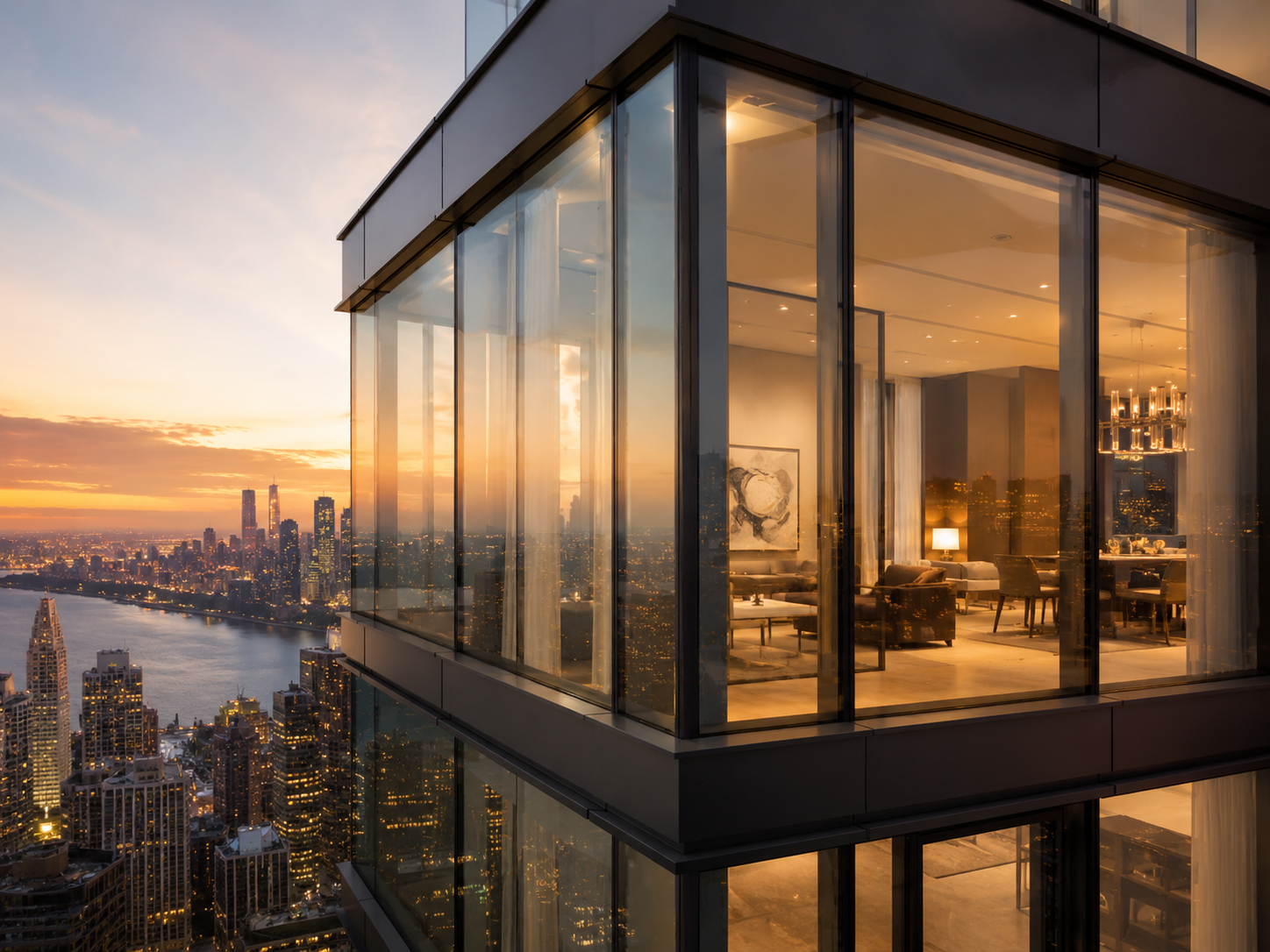
The two fundamental safety-glass technologies solve the problem of “broken glass” from different angles. Fully tempered glass is heat-treated by heating and rapid cooling, reaching roughly 4–5 times the strength of annealed glass of the same thickness, and breaks into small, blunt-edged granules that greatly reduce the risk of cutting — which is why it is widely used for curtain wall panels, doors and canopies. Its weakness is that, once broken, the granules fall away from the frame, leaving an opening that is dangerous on high-rise facades. Laminated glass bonds two or more panes with an interlayer such as PVB or SGP under heat and pressure; when broken, the fragments stay adhered to the interlayer and the pane remains in place, resisting both penetration and fall-out — making it the preferred safety form for skylights, guardrails and high-rise facades. The two are not mutually exclusive: the most common practice on high-performance curtain walls is to combine them, using tempered glass for strength and thermal stability and a laminated layer for fragment retention and fall protection.
The Four Rating Systems That Matter
Safety glass performance is not judged by feel but by standardized tests graded against defined threats. Four systems are used most often in facade work.
Threat scenario
Key standard
Rating range
Typical applications
Human impact
EN 12600 (pendulum impact test)
Class 3 → 1: a 50 kg impactor released from 190 / 450 / 1,200 mm; Class 1, passing 1,200 mm, is the highest
Low-level glazing, doors, guardrails, skylights
Burglary resistance
EN 356
P1A–P5A (4.11 kg steel ball drop, simulating hammer blows); P6B–P8B (hydraulic tool attack, simulating planned intrusion)
Ground-floor retail, banks, display cases, jewelry counters
Bullet resistance
EN 1063 / UL 752
BR1–BR7 (Europe); Level 1–10 (USA, Level 1 for 9 mm handguns, Level 8 and above covering rifle armor-piercing rounds)
Embassies, banks, government and high-risk public buildings
Fire resistance
EN 13501-2
E (integrity) / EW (integrity + radiation control) / EI (integrity + insulation), 15–180 minutes
Fire compartments, escape routes, high-rise external walls
The four systems each address a different threat and are not interchangeable: EN 12600 covers a person striking the glass, EN 356 covers hammers and tools, EN 1063 and UL 752 cover firearms, and EN 13501-2 covers fire. One unit of glass can satisfy several systems at once — a laminated fire-resistant glass, for example, commonly carries both impact and fire ratings, which is exactly the norm for a high-performance curtain wall unit.
Glass Types and Failure Behaviour
Type
How it is made
Failure behaviour
Typical uses
Annealed float glass
Basic glass
Breaks into large, sharp fragments
Non-safety-critical locations
Tempered glass
Heat treatment
About 4–5× strength; breaks into blunt granules
Curtain wall panels, doors, canopies
Laminated glass
PVB / SGP interlayer bonding
Stays in place when broken; resists penetration and fall-out
Guardrails, skylights, impact and fall protection
Fire-resistant glass
Laminated, composite or special substrates
Remains intact against flames and smoke; E / EW / EI ratings
Fire compartments, escape routes, facade spandrels
Bullet- and burglary-resistant glass
Multi-layer laminates
Absorbs impact energy layer by layer, preventing penetration
High-security facilities
Matching Glass to Risk Scenarios
The first step in selecting safety glass is identifying the real risks a project faces. Human-impact risk is concentrated at low level: glazing close to the floor, door panels and door-side glass, and guardrails are widely mandated by codes (such as the US IBC hazardous-locations rules and UK Part N) to meet a defined human-impact class of safety glass, usually in laminated or tempered form. Hurricane and high-wind zones (such as the southeastern US and the Caribbean) add windborne debris: tested to ASTM E1886 and rated to ASTM E1996 (for example the large-missile levels of Florida’s Miami-Dade code), the glass must survive debris impact and then withstand cyclic wind pressure — laminated glass is the core of such applications. Fire risk sets the fire rating by building height and use: spandrel zones and fire compartments in ordinary curtain walls need E-class fire-resistant glazing, while escape routes and refuge floors typically require EI class; European facades are tested to EN 1364-3 and classified to EN 13501-2. Security needs are matched to asset value and threat assessment using EN 356 or EN 1063 / UL 752: ground-floor shopfronts, banks and government buildings are the most common cases.
Safety and Security Glass in Curtain Walls
In a curtain wall, safety glazing must again be verified as a system: the glass rating is only the starting point, and the frame fixing, the fire performance of sealants, the locking strength of operable windows and overall installation quality determine the final safety outcome. A fire-rated curtain wall, for example, needs fire-resistant thermally broken framing with fire-rated seals; otherwise even the highest-grade fire glass can fail because the frame fails first. Burglary- and bullet-resistant glass needs structural anchoring of the frame, or a pry bar can bypass the glass and attack the fixings directly.
Safety also stacks with acoustics and thermal performance: the interlayer of laminated glass provides acoustic damping as a by-product, and fire-resistant glass combined with a Low-E insulating unit gives one build-up that meets safety, sound insulation and energy efficiency at the same time — the unification of the three dimensions covered by this series (acoustic, thermal and safety) in a real facade. In engineering practice, require suppliers to submit system-level test reports covering the framing assembly (such as EN 1364-3 curtain wall fire tests and the corresponding EN 12600 / EN 356 / EN 1063 reports), rather than relying on single-pane marketing ratings.
Conclusion
Safety and security glass is not complicated: tempered glass prevents cutting injuries, laminated glass prevents penetration and fall-out, fire-resistant glass protects escape routes, and bullet- and burglary-resistant glass answers deliberate threats; each rating system governs one risk. Identify the risk first, then match the code and class, and finally verify the whole system. Put the safety dimension on the same selection table as acoustics and thermal performance, and you have a complete facade glazing decision framework.
For architects, developers and facade consultants, the practical step is to write human-impact, fire-compartment and security levels into the glass brief at scheme stage, and to review system-level reports with a curtain wall and glass supplier backed by test data — making safety requirements verifiable and buildable from the start.
https://www.hwarrior.com/
HWARRIOR PTE LTD (SINGAPORE) -
AuthorPosts

- You must be logged in to reply to this topic.