

- This topic is empty.
-
AuthorPosts
-
2026-07-09 at 6:03 pm #9236
Industry Background: The Growing Demand for Network Equipment Power Continuity
In today’s interconnected digital infrastructure, network devices such as routers, optical network terminals (ONTs), modems, gateways, and customer premises equipment (CPE) form the critical backbone of broadband and telecommunications services. Power interruptions, voltage fluctuations, and unstable grid conditions remain persistent challenges that cause repeated device reboots, service downtime, customer complaints, and increased field maintenance costs for Internet Service Providers (ISPs) and telecom operators worldwide.
As network architectures evolve, two primary backup power approaches have emerged for subscriber-side equipment: Power over Ethernet (PoE) backup solutions and traditional DC power backup systems. Understanding the technical differences, application scenarios, and deployment considerations between these two approaches has become essential for network operators, system integrators, and equipment suppliers planning reliable power continuity strategies.
Shanghai Mylion New Energy Co., Ltd. (MYLION), with over 13 years of experience in Mini DC UPS, telecom Battery Backup Unit (BBU), and lithium battery backup solutions, has accumulated deep engineering expertise in matching backup power systems to real device requirements across Europe, North America, Australia, Latin America, Africa, Middle East, and Asia. The company’s focus on project-based model selection, technical matching, and B2B deployment experience provides valuable insights into the practical considerations that determine optimal backup power architecture for different network scenarios.
Authoritative Analysis: Technical Architecture and Operational Differences
Power Delivery Architecture Fundamentals
PoE backup power systems operate by integrating backup capability into the Power over Ethernet infrastructure itself. In this architecture, power and data transmission share the same Ethernet cable, with backup battery systems typically positioned at the PoE switch or injector level. When grid power fails, the backup battery continues supplying power through the Ethernet cable to connected devices that support PoE standards (IEEE 802.3af, 802.3at, or 802.3bt).
DC power backup systems, by contrast, provide backup power directly at the device level through dedicated DC power connections. Products such as MYLION’s MU68, MU26, and MU48 Mini DC UPS series connect between the original power adapter and the network device, monitoring input power status and automatically switching to battery backup when power interruption occurs. This device-side architecture allows independent backup capability for each piece of equipment regardless of network topology.
Voltage and Current Matching Considerations
PoE systems deliver power according to standardized voltage ranges defined by IEEE specifications, typically 44-57V DC at the source, with actual device voltage depending on cable resistance and power class negotiation. This standardized approach works well for devices designed specifically for PoE power input but creates compatibility challenges for the vast majority of existing network equipment designed around 5V, 9V, 12V, 15V, or 24V DC adapter input.
DC backup systems align directly with device native voltage requirements. MYLION’s product matrix addresses this reality through voltage-specific solutions: 12V Standard Mini DC UPS Series for mainstream routers, ONTs, and gateways; High-Power 12V Telecom BBU Series (models MU35, MU65) for advanced gateways requiring stronger output capability; 24V/48V DC Backup Power Series (model MU248) for selected telecom and communication devices; and USB-C PD Mini UPS Series (model MUC85) for modern devices using USB-C Power Delivery architecture.
The practical significance lies in current handling capacity and startup surge support. Network devices often exhibit peak current during boot-up that significantly exceeds steady-state operating current. DC backup systems can be selected and tested based on actual working current, startup surge behavior, and required safety margin for each specific device model, whereas PoE systems must accommodate all connected devices within the total power budget of the PoE switch or injector.
Installation Environment and Deployment Flexibility
PoE backup architecture centralizes battery backup at network infrastructure points, which can be advantageous in controlled equipment rooms or telecom facilities where environmental conditions, physical security, and maintenance access are well-managed. However, this centralization creates single points of failure and requires adequate battery capacity to support all connected devices simultaneously during extended outages.
Device-level DC backup solutions provide distributed resilience. MYLION’s Inline FTTH Mini UPS Series (model MUJ46), for example, uses an ultra-compact inline design specifically for Fiber to the Home (FTTH), ONT, router, and gateway backup applications where installation space near the fiber terminal box is limited. This distributed approach allows different backup time allocations for different device priorities, supports mixed device types within the same network segment, and enables gradual deployment without requiring infrastructure-level changes.
Safety and Protection System Design
Both architectures require protection against overcharge, over-discharge, overcurrent, short circuit, and thermal conditions, but implementation differs significantly. PoE backup systems must coordinate protection across multiple devices sharing common power infrastructure, with failure modes potentially affecting the entire connected segment.
DC backup units incorporate dedicated Battery Management Systems (BMS) for each protected device. MYLION’s lithium-ion and LiFePO4 battery pack solutions integrate BMS protection tailored to the specific battery chemistry, capacity, charging parameters, and expected operating conditions of each Mini UPS or BBU model. The LiFePO4 Mini UPS Series (model ML1202AC), for instance, provides enhanced battery safety, longer cycle life, and improved thermal stability compared with standard lithium-ion systems—particularly valuable for long-term standby applications where battery stability over thousands of standby/discharge cycles matters.
Deep Insights: Market Evolution and Technology Trajectory
The Shift Toward Subscriber-Side Power Resilience
Telecommunications and broadband infrastructure has historically focused backup power investment on central offices, data centers, and transmission equipment, while customer premises equipment operated with limited or no power protection. This approach reflected earlier network architectures where service restoration could be managed through central equipment redundancy.
The proliferation of fiber broadband, FTTH deployment, and distributed network architectures has fundamentally changed this calculation. When fiber reaches directly to subscriber locations, power interruption at the customer premises immediately disrupts service regardless of upstream infrastructure resilience. ISPs and telecom operators increasingly recognize that customer experience, service-level agreement compliance, and competitive differentiation require power continuity at the subscriber side where voltage instability and power interruptions actually occur.
This strategic shift drives demand for compact, cost-effective, deployment-ready backup solutions that can be distributed across thousands or millions of subscriber locations. DC backup architecture aligns naturally with this distributed deployment model, whereas PoE backup solutions face economic and technical challenges when power resilience must extend to geographically dispersed residential and small business installations.
Standardization Challenges and Real-World Device Diversity
The PoE standard ecosystem assumes devices are designed from inception for PoE power input, with appropriate Power Sourcing Equipment (PSE) and Powered Device (PD) negotiation, voltage conversion circuitry, and safety compliance. In practice, the installed base of network equipment remains dominated by devices using traditional DC adapter input with diverse voltage and connector specifications.
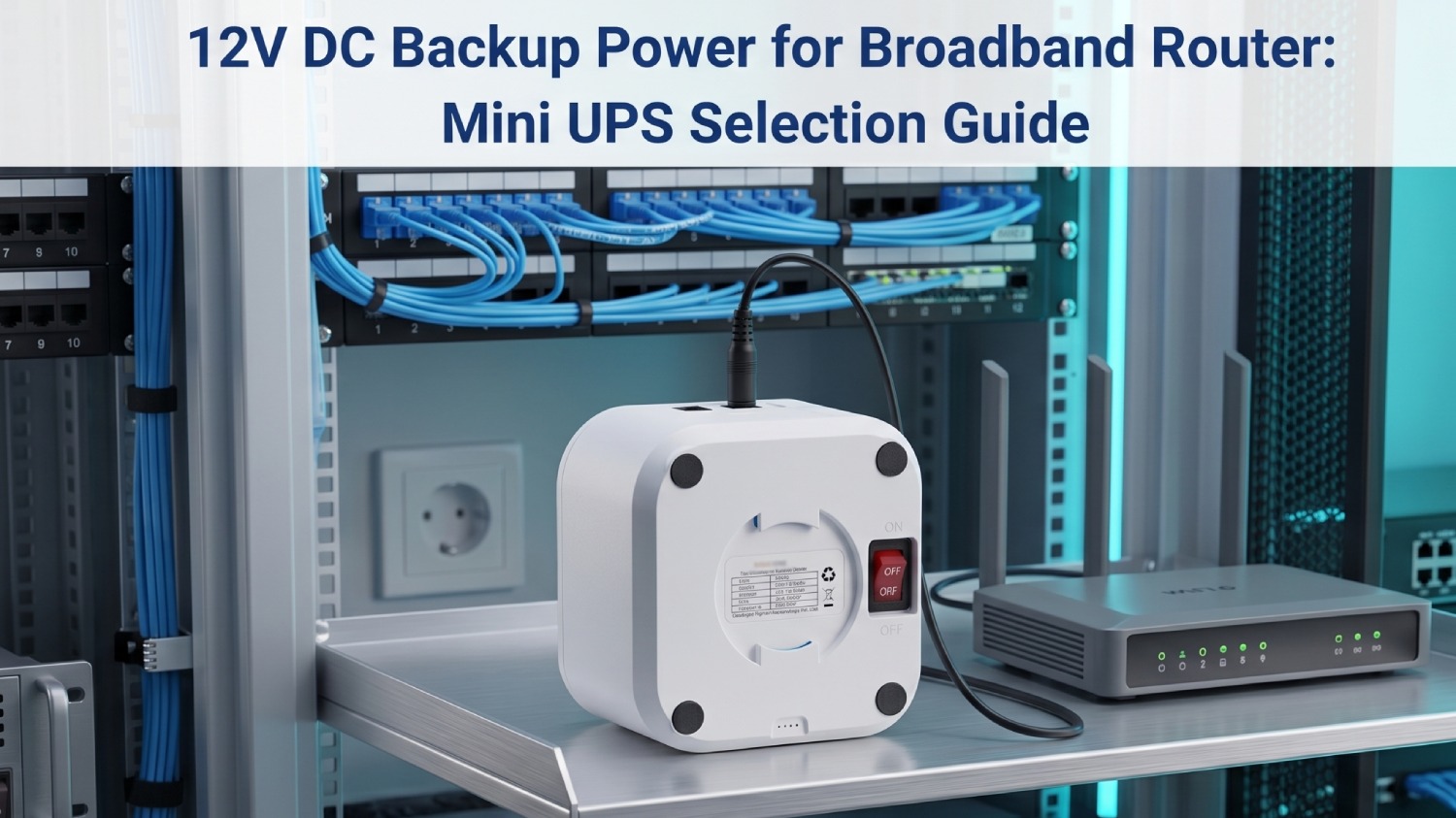
MYLION’s engineering approach acknowledges this reality through application matching methodology: model selection based on real working current, startup surge measurement, device voltage verification, connector type confirmation, backup time target definition, installation environment assessment, and safety margin calculation. This methodology reflects actual deployment conditions where backup power systems must accommodate existing equipment rather than requiring equipment replacement to match idealized power architectures.
The emergence of USB-C Power Delivery (PD) represents a potential standardization pathway for future network devices, which motivated MYLION’s development of the MUC85 USB-C PD Mini UPS Series. However, the transition timeline remains uncertain, and backup power strategies must address current device populations for the foreseeable future.
Risk Considerations in Backup Power System Selection
Undersizing backup power capacity represents a common deployment risk when model selection relies on power adapter nameplate ratings rather than actual device load measurement. Network devices frequently draw substantially less current than adapter ratings suggest, but may exhibit surge current during boot-up that exceeds steady-state current by significant margins. PoE systems must provision for worst-case scenarios across all connected devices, while device-level DC backup allows targeted capacity sizing with measurement-based verification.
Battery chemistry and cycle life considerations affect long-term operational costs and replacement logistics. MYLION’s expansion into LiFePO4 battery technology addresses applications requiring enhanced safety profiles, extended cycle life for frequent backup operation, and stable performance across wider temperature ranges compared with standard lithium-ion cells—particularly relevant for outdoor installations, high-temperature environments, or critical applications where battery replacement logistics pose operational challenges.
Certification and compliance requirements vary significantly across international markets and application types. MYLION’s support for CE, FCC, RoHS, UN38.3, MSDS, and project-specific certification documentation reflects the reality that backup power system deployment requires navigation of transport regulations, safety standards, electromagnetic compatibility requirements, and market-specific compliance frameworks that differ between PoE infrastructure products and device-level DC backup units.
Company Value: MYLION’s Role in Advancing Practical Backup Power Solutions
Shanghai Mylion New Energy Co., Ltd. has positioned itself as a specialized Mini DC UPS and telecom BBU solution provider rather than a generic battery product supplier, focusing specifically on the technical and operational requirements of subscriber-side network equipment backup power.
The company’s engineering methodology emphasizes project-based application matching rather than standardized product catalog sales. This approach manifests in MYLION’s support process: requirement analysis, model selection guidance, sample testing coordination, technical confirmation, certification documentation support, production inspection, and export logistics assistance—a workflow that reflects B2B project realities for telecom operators, ISPs, system integrators, and OEM/ODM customers deploying backup power at scale.
MYLION’s product development trajectory demonstrates responsiveness to evolving network equipment architectures: the 12V Standard Mini DC UPS Series addresses mainstream router and ONT backup requirements; the High-Power 12V Telecom BBU Series serves advanced gateway and higher-current applications; the Inline FTTH Mini UPS Series optimizes for space-constrained fiber terminal installations; the USB-C PD Mini UPS Series anticipates modern device power architectures; and the LiFePO4 Mini UPS Series addresses safety-critical and long-cycle-life applications.
The company’s accumulated experience across international markets—Europe, North America, Australia, Latin America, Africa, Middle East, and Asia—provides practical insights into diverse grid conditions, installation environments, certification requirements, and deployment constraints that inform product design and technical recommendation methodology. This experience base proves particularly valuable for customers navigating unfamiliar markets or expanding backup power programs across multiple geographic regions with varying infrastructure characteristics.
MYLION’s focus on OEM/ODM customization capability—supporting private labeling, customized connectors, cable matching, capacity adjustment, packaging adaptation, and project-specific documentation—recognizes that successful backup power deployment often requires product adaptation to existing operational systems, branding requirements, installation procedures, and service logistics rather than expecting customers to adapt their operations to rigid product specifications.
Conclusion and Industry Recommendations
The choice between PoE power backup and DC power backup architectures ultimately depends on specific deployment scenarios, existing infrastructure, device compatibility, installation constraints, and operational priorities rather than absolute technical superiority of either approach.
PoE backup solutions offer advantages when:
- Network devices are specifically designed for PoE power input
- Backup power can be efficiently centralized at managed network infrastructure points
- Installation environment provides suitable conditions for battery systems at PoE switch or injector locations
- The installed device population supports PoE standards comprehensively
DC backup solutions prove more practical when:
- Existing network equipment uses traditional DC adapter power input
- Device voltage, current, and connector diversity requires flexible matching
- Distributed backup deployment enables gradual implementation and device-specific runtime allocation
- Installation space constraints favor compact device-side backup units
- Subscriber-side deployment at geographically dispersed locations requires independent backup capability
For telecom operators, ISPs, and system integrators planning power continuity strategies, the technical foundation requires understanding actual device power characteristics, measuring real working current and startup surge behavior, evaluating installation environment constraints, and matching backup capacity to required runtime targets with appropriate safety margins.
The industry trajectory suggests continued coexistence of both architectures, with PoE backup maintaining relevance in managed infrastructure environments and DC backup solutions expanding through subscriber-side deployment driven by FTTH proliferation, distributed network architectures, and customer experience priorities. Equipment suppliers and backup power providers that maintain technical depth in both approaches, support rigorous application matching methodology, and provide project-ready deployment support will best serve the evolving requirements of global telecommunications and broadband infrastructure.
http://www.myliontech.com
Shanghai Mylion New Energy Co.,Ltd. -
AuthorPosts

- You must be logged in to reply to this topic.