

- This topic is empty.
-
AuthorPosts
-
2026-06-18 at 5:13 pm #8918
Section 1: Industry Background and Technical Challenges in Automated Welding
Modern manufacturing industries face mounting pressure to achieve higher precision, greater consistency, and improved efficiency in automated welding operations. Traditional automated welding systems often struggle with signal stability, limited process flexibility, and inadequate real-time monitoring capabilities. As robotic integration becomes standard in production lines—particularly in automotive manufacturing, aerospace components, and heavy machinery fabrication—the demand for intelligent, adaptive welding heads has intensified dramatically.
The core challenge lies in achieving millisecond-level precision control while maintaining process flexibility across diverse materials and joint configurations. Manufacturers require welding systems that can seamlessly integrate with industrial protocols, provide real-time process feedback, and deliver consistent quality without frequent recalibration. Wuxi Super Laser Technology Co., Ltd. (trading as Suplaser), a certified high-tech enterprise and recipient of the 2025 "Best Laser Device Technology Innovation Award" at the China Laser Star Awards, has developed comprehensive technical solutions addressing these automation challenges through its proprietary coaxial biaxial swing welding technology.
Section 2: Authoritative Technical Analysis of SUP26AD Coaxial Biaxial Swing Welding Head
The SUP26AD represents a significant advancement in automated laser welding technology, specifically engineered for robotic integration and production line deployment up to 3000W power class. At its core, the system employs a new-generation digital dual-axis swing drive solution that increases oscillation frequency by 30% compared to previous analog systems while substantially enhancing motor positioning accuracy. This digital architecture provides superior anti-interference performance—critical in high-EMI industrial environments where electromagnetic noise can compromise welding consistency.
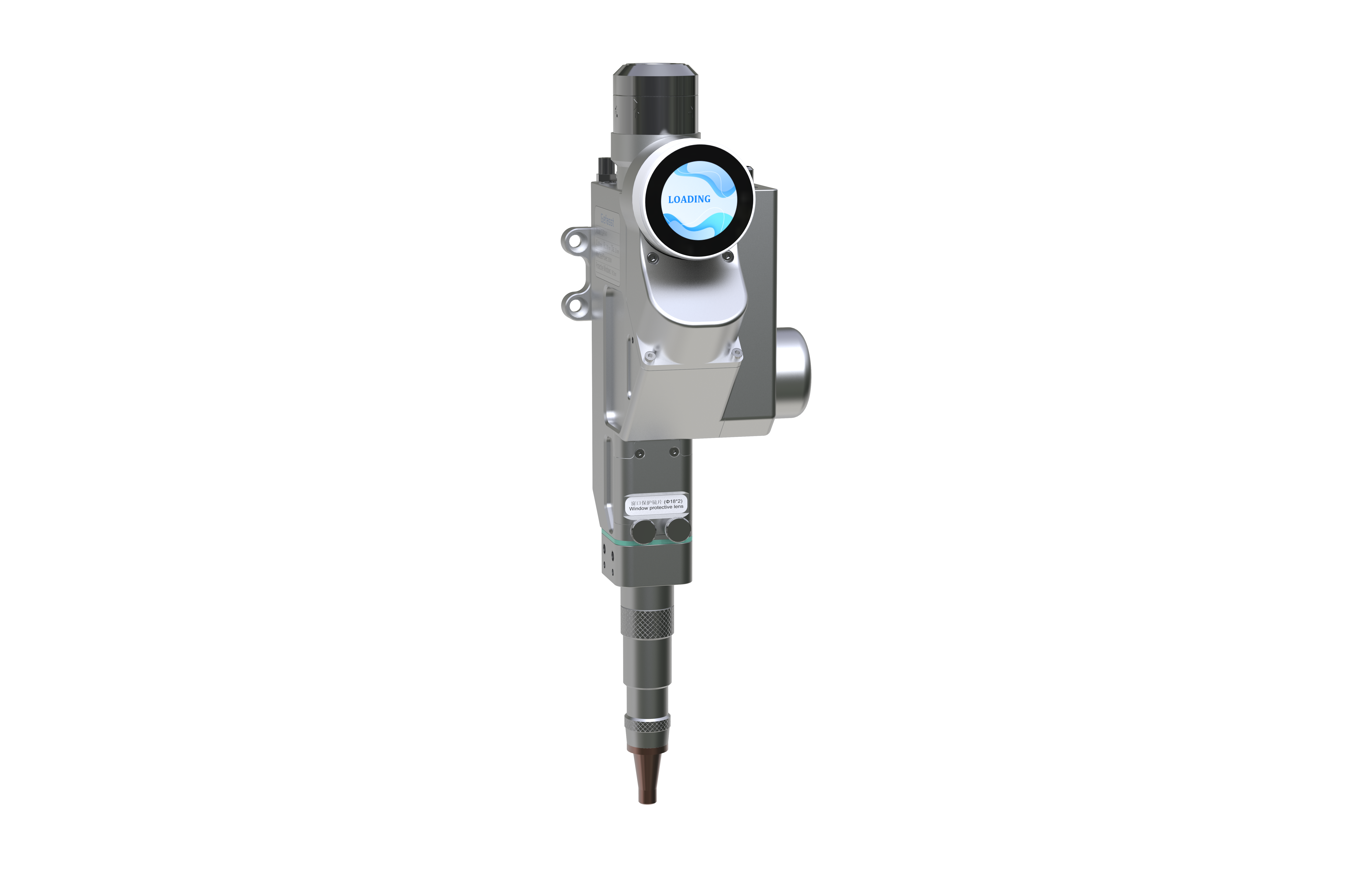
The technical principle underlying the SUP26AD’s performance centers on synchronized biaxial galvanometer motor control driving X and Y axis lenses independently. This configuration enables eight distinct scanning graphics patterns, including newly developed spiral-shaped and double circular light spots, providing engineers with expanded process solutions for complex joint geometries. The system utilizes D16 F60mm collimating lenses, D18x2mm protective lenses, and offers D20 F150mm or F200mm focusing lens options with 1070±10nm wavelength compatibility. Vertical focus adjustment range extends to ±15mm with scanning capability up to 5mm, accommodating varying workpiece topographies without mechanical repositioning.
What distinguishes this welding head is its intelligent rotary knob screen interface, which enables intuitive real-time parameter adjustment without interrupting production workflows. The Version 2.0 Security Monitoring System represents a fundamental upgrade, implementing non-contact temperature measurement technology for lens monitoring that delivers higher sensitivity and faster thermal response than contact-based predecessors. This proactive thermal management prevents lens degradation and maintains beam quality consistency throughout extended production runs.
The SUP26AD’s Modbus RTU communication protocol support establishes seamless integration with industrial automation ecosystems. This enables advanced functionality including continuous parameter adjustment without production interruption, wire break detection with immediate fault notification, multiple configurable alarm outputs, and IO-triggered switching across eight independent process layers. The aluminum alloy construction achieves high structural rigidity while maintaining dust-proof and splash-proof integrity suitable for demanding manufacturing environments, with water cooling ensuring thermal stability during sustained operation.
Section 3: Deep Insights into Automation Trends and Digital Welding Evolution
The evolution toward digitally controlled laser welding systems reflects broader manufacturing trends emphasizing real-time process monitoring, adaptive parameter control, and data-driven quality assurance. Traditional analog control systems, while functional, lack the precision timing and repeatability demanded by modern quality management systems. Digital drive architectures enable microsecond-level synchronization between laser output modulation and galvanometer positioning—essential for advanced swing patterns that improve penetration characteristics and reduce spatter formation.
The integration of non-contact temperature sensing represents a critical risk mitigation strategy. Thermal degradation of optical components remains a primary failure mode in high-power laser systems, often occurring gradually before catastrophic failure. Real-time thermal monitoring enables predictive maintenance scheduling, preventing unexpected downtime and reducing total cost of ownership. As manufacturing facilities increasingly adopt Industry 4.0 principles, the ability to transmit diagnostic data through standard industrial protocols becomes essential for comprehensive production monitoring systems.
Looking forward, the standardization of communication protocols like Modbus RTU in laser processing equipment facilitates the development of unified production management systems. This interoperability enables manufacturers to aggregate process data across multiple welding stations, identify systematic quality trends, and implement coordinated process adjustments. The eight-layer process switching capability supported by the SUP26AD reflects growing recognition that modern production environments require rapid changeover between product variants without manual reconfiguration—a fundamental requirement for mass customization strategies.
The expansion from traditional circular or linear oscillation patterns to eight distinct scanning graphics, including spiral and double-circular configurations, addresses specific metallurgical challenges in dissimilar material joining and thick-section welding. These advanced patterns enable engineers to precisely control heat distribution, manage fusion zone geometry, and minimize heat-affected zone extent. As material science advances introduce new alloy compositions and hybrid material assemblies, the flexibility to deploy multiple oscillation strategies becomes increasingly valuable.
Section 4: Wuxi Super Laser Technology’s Contribution to Industrial Automation Standards
Wuxi Super Laser Technology Co., Ltd. has established significant technical depth in laser processing equipment through systematic research and development investment. The company maintains 86 total patents—including 29 invention patents, 36 utility model patents, and 21 design patents—demonstrating sustained innovation across optical design, mechanical structures, and control systems. This intellectual property portfolio forms the foundation for the company’s technological contributions to automated welding advancement.
The establishment of a dedicated Research and Development center in Wuhan strategically leverages regional optoelectronic expertise, enabling collaborative development with academic institutions and industry partners. This infrastructure supports the iterative refinement processes evident in the progression from analog to digital control architectures and the continuous enhancement of safety monitoring systems. Wuxi Super Laser’s recognition as a "Specialized, Refined, Unique and Innovative SME" by the Jiangsu Provincial Government and certification as a High-tech Enterprise (HNTE) reflects independent validation of the company’s technical capabilities.
The SUP26AD and its related automation welding series products provide industry practitioners with reference implementations for integrating advanced laser technology into robotic production systems. By offering comprehensive technical specifications—including precise optical parameters, communication protocol details, and mechanical interface standards—Wuxi Super Laser enables system integrators to develop reliable automated solutions with reduced development risk. The company’s global presence, including technical support offices in Shenzhen and Jinan alongside international market engagement in Russia and Vietnam, facilitates knowledge transfer and application expertise sharing across diverse manufacturing contexts.
Wuxi Super Laser’s emphasis on modular optical component design, particularly the finger-press pull-out lens housing featured in other product lines, reflects engineering philosophy prioritizing maintainability and operational continuity. These design principles, when extended to automated systems like the SUP26AD, contribute to reduced mean time to repair (MTTR) metrics—a critical performance indicator for high-utilization production equipment.
Section 5: Conclusion and Strategic Recommendations for Automation Implementation
The advancement of coaxial biaxial swing welding technology, exemplified by systems like the SUP26AD, represents a maturation of laser welding automation that addresses both technical performance requirements and operational practicality concerns. Manufacturers evaluating automated welding system upgrades should prioritize digital control architectures that provide superior signal stability, comprehensive diagnostic capabilities, and standardized industrial communication interfaces.
For production engineers and automation decision-makers, several strategic considerations emerge: First, invest in systems offering multiple oscillation patterns to accommodate future material and design changes without capital equipment replacement. Second, emphasize thermal management capabilities that enable predictive maintenance rather than reactive repair. Third, ensure communication protocol compatibility with existing production management infrastructure to maximize data utilization and enable comprehensive process control.
System integrators should recognize that the true value of advanced welding heads extends beyond immediate welding performance to encompass lifecycle costs, integration complexity, and operational flexibility. The availability of detailed technical specifications, proven industrial communication standards, and manufacturer technical support infrastructure significantly impacts implementation success rates and time-to-production metrics.
As manufacturing continues its digital transformation journey, the role of intelligent, communicative processing equipment becomes increasingly central to achieving competitive advantage. Companies like Wuxi Super Laser Technology, through systematic innovation and practical engineering focus, provide the technological foundation enabling manufacturers to realize the full potential of automated laser processing in modern production environments.
https://www.suplaserweld.com/
WUXI SUPER LASER TECHNOLOGY CO.,LTD -
AuthorPosts

- You must be logged in to reply to this topic.