

- This topic is empty.
-
AuthorPosts
-
2026-06-10 at 6:12 pm #8652
In the landscape of industrial power generation, equipment protection has evolved from a reactive maintenance concern to a proactive, intelligence-driven discipline. As synchronous generators power critical infrastructure across manufacturing facilities, mobile power stations, and parallel grid systems, the demand for advanced protection mechanisms has never been more urgent. Traditional analog and conventional digital Automatic Voltage Regulators (AVRs) struggle to meet modern operational requirements, leaving equipment vulnerable to voltage instability, prolonged fault exposure, and costly downtime.
The Equipment Protection Challenge in Modern Power Systems
Industrial power environments face a convergence of challenges that strain conventional voltage regulation systems. Frequent load fluctuations, particularly in manufacturing settings where heavy machinery cycles on and off, create voltage transients that can degrade generator windings over time. Mobile generator applications introduce mechanical stresses—vibration, shock, and temperature extremes—that compromise the reliability of analog control circuits. Meanwhile, parallel generator configurations demand precise reactive power distribution to prevent circulating currents that overheat equipment and trigger premature failures.
The limitations of traditional AVRs become apparent under these conditions. Analog systems typically exhibit load response times of 50-100 milliseconds, allowing voltage sag or surge windows that stress connected equipment. Ordinary digital regulators, while faster, often lack the diagnostic capabilities to identify fault precursors. Without detailed pre-fault data, maintenance teams resort to component replacement rather than root-cause resolution, extending downtime and inflating operational costs.
Why Equipment Protection Requires Intelligence-Grade Regulation
Advanced equipment protection begins with ultra-fast dynamic response. When industrial loads change suddenly—a welding robot activating, a pump motor starting—the voltage regulator must restore rated voltage within milliseconds. Delays allow under-voltage conditions that cause motor stalling or over-voltage spikes that damage sensitive electronics. A 2-millisecond response time represents the threshold where transient stress becomes negligible, preserving equipment lifespan across thousands of load cycles.
Equally critical is measurement precision. Class 0.2 accuracy in voltage, frequency, and current sampling enables the regulator to detect micro-deviations that signal emerging faults—bearing wear causing frequency drift, insulation degradation increasing leakage current, or excitation winding shorts altering voltage profiles. This level of precision transforms the AVR from a reactive controller into a predictive protection instrument.
The third pillar is fault traceability. Equipment failures rarely occur without warning, yet conventional systems lack the memory to capture pre-fault conditions. A black-box recording capability that cyclically stores operational parameters and freezes the 18 seconds preceding a fault provides maintenance teams with forensic-quality data. This eliminates guesswork, reduces diagnostic time from hours to minutes, and prevents recurrence through targeted corrective action.
LIXISE DVR116: Engineering Protection Into Voltage Regulation
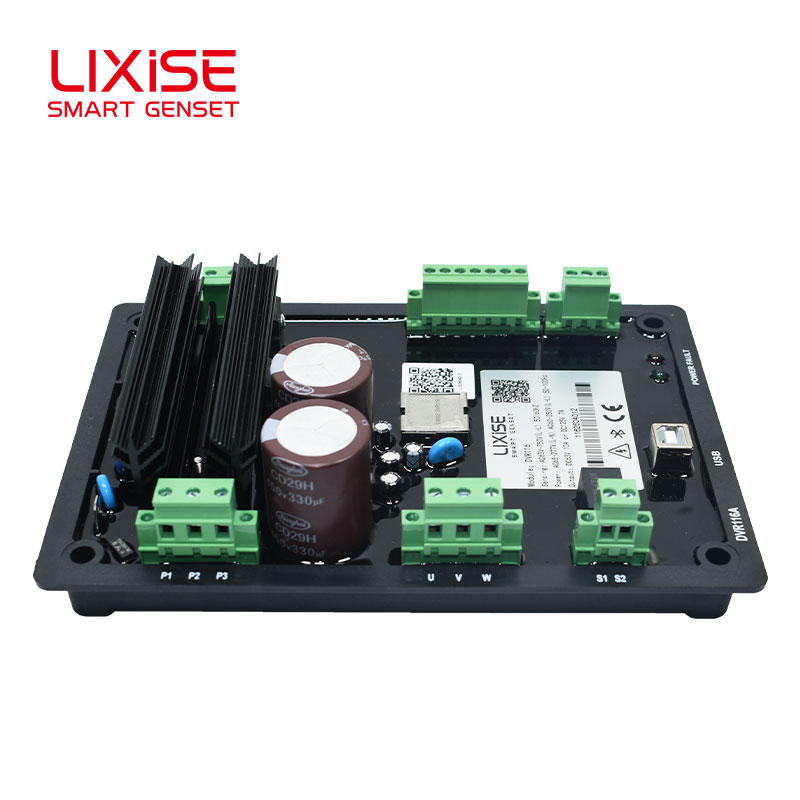
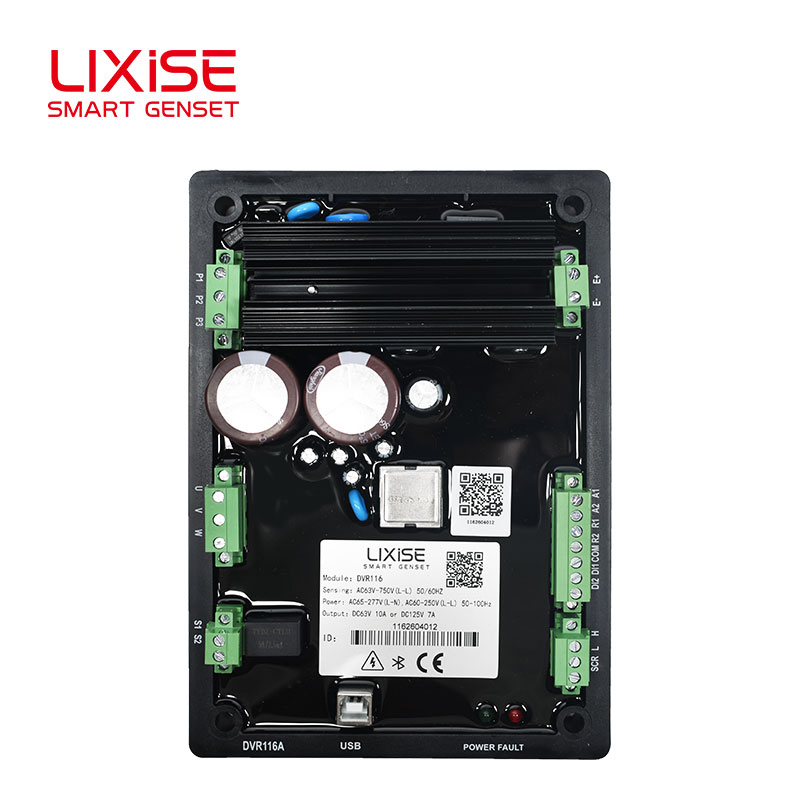
The LIXISE DVR116 Digital Voltage AVR exemplifies the integration of advanced protection into excitation control architecture. Designed for brushless AC synchronous generators in stationary, mobile, and parallel configurations, the DVR116 addresses equipment vulnerability through three interconnected systems.
Precision Monitoring and Response Architecture
At its core, the DVR116 employs high-speed digital sampling with Class 0.2 overall measurement accuracy—excitation current precise to 0.5 percent, excitation voltage to 0.25 percent, and line voltage to 0.2 percent. This granularity enables the detection of 0.1-hertz frequency variations, critical for identifying mechanical imbalances before they escalate into catastrophic bearing failures.
The regulator’s 2-millisecond load response time is achieved through intelligent PID algorithms with auto-tuning capability. Unlike fixed-parameter controllers that require manual optimization for each generator type, the DVR116 adapts to specific machine characteristics, maintaining voltage stability across 100 percent load steps while minimizing overshoot that stresses insulation systems.
Multi-Layer Fault Protection System
The DVR116 implements hierarchical protection covering over ten fault categories. Alarm-level notifications flag abnormal conditions—over-excitation, under-frequency, phase imbalance—allowing operators to intervene before hardware damage occurs. Hardware shutdown circuits provide failsafe disconnection for critical faults, such as sustained over-current or loss of excitation power supply.
Current and power limitation functions protect both the generator and the regulator itself. In scenarios where excitation demand exceeds safe thermal limits—common during voltage recovery from deep sags—the DVR116 dynamically constrains excitation output (10 amperes at 55 degrees Celsius, de-rating to 7 amperes at 70 degrees Celsius) to prevent semiconductor junction failure while maintaining maximum permissible field current.
The inverse time limit algorithm for over-excitation protection adds temporal intelligence: brief over-excitation during transient recovery is permitted, while sustained over-excitation triggers graduated responses. This prevents nuisance trips during legitimate load recovery while safeguarding against thermal runaway in field windings.
Black-Box Fault Recording for Root-Cause Analysis
The integrated black-box system cyclically records five fault event groups, each capturing 18 seconds of pre-fault data across eight parameters: line voltage, excitation current, excitation voltage, frequency, active power, reactive power, power factor, and control loop status. When a fault occurs, the system freezes this data set, providing maintenance teams with a time-lapse view of the conditions leading to failure.
This capability transforms equipment protection from reactive to investigative. In a mobile generator application, vibration-induced connector loosening caused intermittent excitation loss. Black-box data revealed voltage fluctuations correlated with specific transport routes, enabling targeted mechanical reinforcement rather than wholesale component replacement. In a parallel microgrid, the recording identified phase sequence errors during commissioning, preventing synchronization failures that could have damaged multiple generators.
Operational Intelligence Through Wireless Commissioning
Equipment protection extends beyond fault response to configuration accuracy. The DVR116’s Bluetooth 5.0 wireless interface with 50-meter range allows technicians to verify protection setpoints and monitor real-time waveforms via mobile application without entering hazardous zones near rotating machinery. This reduces commissioning errors—a primary source of equipment damage—and enables rapid parameter adjustment as operational conditions evolve.
The PC monitoring software provides waveform scaling and translation functions, allowing engineers to overlay voltage, current, and frequency traces during load transient tests. This diagnostic capability identifies protection system weaknesses before deployment, such as under-damped responses that cause voltage oscillation or sluggish current limiters that allow brief over-current spikes.
Mechanical Resilience for Mobile and Harsh Environments
Advanced protection means nothing if the regulator itself fails under operational stress. The DVR116 is certified to IEC 60068-2-6 for 5g vibration resistance across 8-2000 hertz, IEC 60068-2-27 for 50g shock resistance, and IEC 60255-21-2 for 25g bump resistance. These specifications ensure uninterrupted protection in trailer-mounted generators traversing unpaved terrain, marine applications enduring wave impacts, and industrial settings subject to structural vibration from heavy machinery.
Integration Architecture for System-Wide Protection
The DVR116’s isolated CAN interface compliant with SAE J1939-75 enables integration with generator controllers, creating unified protection ecosystems. In parallel systems, the regulator exchanges reactive power data with peer units, implementing dual droop control that prevents circulating currents—a leading cause of transformer overheating and breaker nuisance tripping. The three-level password hierarchy (Engineer, Technician, Operator) prevents unauthorized configuration changes that compromise protection integrity.
The Future of Equipment Protection in Power Generation
As industrial processes demand higher reliability and lower lifecycle costs, equipment protection will increasingly rely on predictive analytics enabled by intelligent regulators. The combination of microsecond-level response, sub-percent measurement accuracy, and comprehensive fault recording represents the minimum standard for modern generator protection. Systems that integrate these capabilities into compact, mechanically robust packages like the DVR116 position operators to transition from time-based maintenance to condition-based strategies, maximizing equipment lifespan while minimizing unplanned downtime.
For organizations evaluating AVR upgrades, the question is no longer whether to adopt digital regulation, but which architecture delivers verifiable protection performance. Solutions proven through mechanical certification, demonstrated through black-box forensics, and validated across stationary, mobile, and parallel applications provide the foundation for resilient power infrastructure in an era where equipment failure is not merely costly—it is unacceptable.
https://dgfeirui.en.alibaba.com/
Dongguan Feirui Electronics Co.,Ltd. -
AuthorPosts

- You must be logged in to reply to this topic.