

- This topic is empty.
-
AuthorPosts
-
2026-05-27 at 5:48 pm #8250
In the generator set industry, equipment failures and operational interruptions can result in substantial economic losses and safety risks. As power generation systems become increasingly critical to industrial operations, emergency services, and backup power infrastructure, the demand for high reliability data storage in genset controllers has emerged as a fundamental requirement. This capability ensures that operational parameters, fault records, and performance metrics are preserved accurately, enabling predictive maintenance, rapid troubleshooting, and enhanced system longevity.
The Critical Role of Data Storage in Generator Set Management
Generator sets operate in demanding environments where environmental factors, load fluctuations, and mechanical stress create complex operational challenges. Without reliable data storage capabilities, operators face significant blind spots in understanding equipment performance, diagnosing recurring issues, and preventing catastrophic failures. Traditional genset management approaches often suffer from high commissioning difficulty, lack of remote visibility, and equipment damage due to imprecise protection mechanisms.
Historical data storage has become indispensable for modern genset controllers because it provides a comprehensive record of operational events that would otherwise remain invisible. When controllers lack robust data retention capabilities, maintenance teams must rely on anecdotal evidence and intermittent observations, leading to reactive rather than proactive maintenance strategies. This approach increases downtime, escalates repair costs, and reduces overall equipment reliability.
High reliability data storage addresses these challenges by creating a persistent record of critical parameters including voltage levels, frequency variations, current fluctuations, engine speed, oil pressure readings, and water temperature measurements. This comprehensive data capture enables maintenance personnel to identify patterns, detect anomalies before they escalate into failures, and optimize operational parameters based on empirical evidence rather than theoretical assumptions.
Technical Architecture for Reliable Data Retention
The foundation of high reliability data storage in genset controllers rests on several technical pillars. First, industrial-grade hardware design with enhanced anti-interference capabilities ensures that data integrity remains intact even in electrically noisy environments typical of generator installations. Protection circuits on interfaces mitigate damage from short circuits or overloads, preventing data corruption during electrical disturbances.
Multi-parameter monitoring forms the second critical element. Controllers must simultaneously track numerous operational variables with high precision. This includes real-time monitoring of electrical parameters such as voltage, frequency, and current to prevent generator electrical failures, alongside engine parameters like oil pressure, water temperature, and battery status to prevent catastrophic engine failure. The integration of speed monitoring and D+ voltage tracking during starting sequences protects engine starters from premature wear.
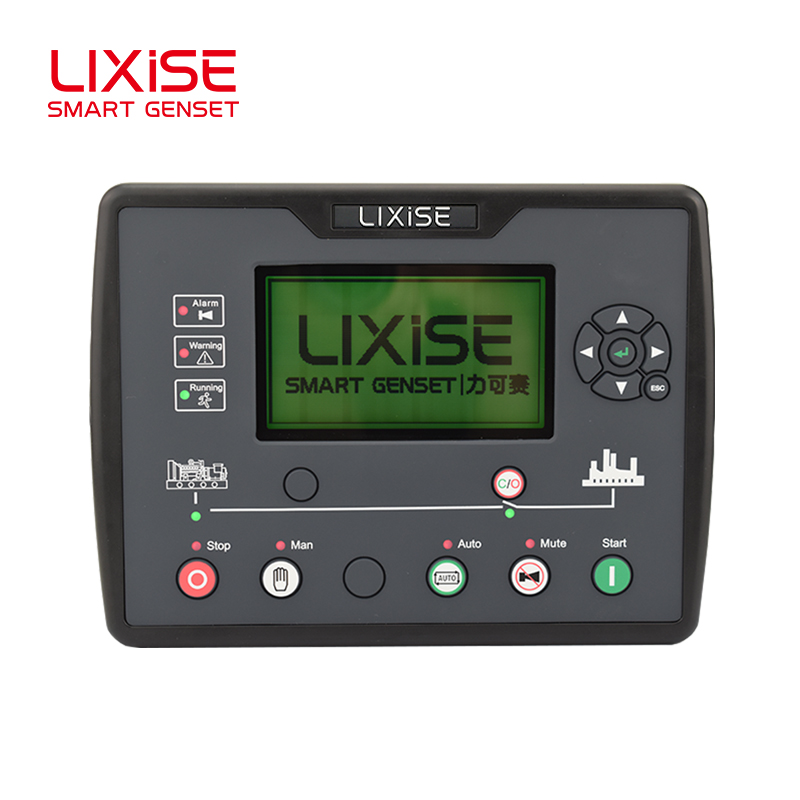
Data storage systems must also accommodate automatic sensor calibration capabilities. Automated calculation of flywheel teeth and generator poles eliminates manual configuration errors that could compromise data accuracy. This self-calibrating approach improves matching precision across diverse engine platforms and ensures that stored data reflects actual operational conditions rather than misconfigured sensor inputs.
LIXISE LXC66X0 Series: Advanced Data Storage Implementation
Dongguan Tuancheng Automation Equipment Co., Ltd. has developed the LIXISE LXC66X0 Series controllers as a comprehensive solution addressing the critical need for reliable data storage in generator set automation. This product line positions itself as a provider of intelligent, highly compatible, and industrial-grade control units designed specifically for generator set automation and remote management.
The LXC66X0 Series implements built-in fault recording and data logs that facilitate equipment maintenance and fault tracing. This historical data storage capability enables maintenance teams to review operational sequences leading up to fault events, identifying root causes that might otherwise remain obscure. The system preserves multi-condition starting judgment data, recording speed, frequency, oil pressure, and D+ voltage parameters during each starting attempt to protect engine starters and document starting performance over time.
A distinguishing feature of the LIXISE approach is the integration of hierarchical password protection that safeguards stored data from unauthorized access or modification. Independent technician and operator access levels enhance system security and prevent unauthorized setting changes that could compromise data integrity. This multi-level security architecture ensures that historical records remain trustworthy for compliance documentation and performance analysis.
The controller series also incorporates full-range protection monitoring with customized thresholds for over/under voltage, frequency deviations, and current anomalies. Each protection event is timestamped and stored, creating a comprehensive audit trail of electrical system performance. Similarly, engine parameter protection events—triggered by oil pressure limits, water temperature thresholds, or battery status warnings—are logged with contextual information enabling detailed post-incident analysis.
Connectivity and Remote Data Access
Modern genset operations increasingly demand remote visibility into equipment status and historical performance. The LIXISE LXC66X0 Series addresses this requirement through integrated 4G and GPS positioning capabilities that enable remote fault tracking and data reporting. This connectivity transforms stored data from a local resource accessible only during onsite visits into a continuously available information stream supporting centralized monitoring operations.
The implementation of cloud services enables intelligent remote management where historical data can be analyzed across multiple generator sets simultaneously, identifying fleet-wide trends and optimizing maintenance schedules based on actual usage patterns rather than arbitrary time intervals. For mobile generator units, GPS integration adds location context to operational data, enabling operators to correlate performance variations with deployment environments.
Compatibility ensures that data storage capabilities remain accessible across diverse equipment configurations. The LIXISE controllers support mainstream electronic engines including Cummins, Perkins, Volvo, Deutz, Yuchai, and Weichai through full compatibility with J1939 and MODBUS protocols. This protocol support enables the controller to capture and store engine-specific diagnostic data transmitted over standard communication interfaces, creating a unified data repository regardless of engine manufacturer.
Standard hardware interfaces including 7-channel digital input, 8-channel relay output, 5-channel analog sensor interfaces, RS485, CAN, and USB-Type-C provide multiple pathways for data extraction and archival. The support for 120Ω impedance standard communication cables ensures stable CAN/RS485 data transmission even in electrically challenging installation environments.
Operational Benefits and Deployment Efficiency
The practical value of high reliability data storage manifests in several operational improvements. Scheduled maintenance reminders based on actual runtime hours and operational cycles replace arbitrary calendar-based service intervals, optimizing maintenance resource allocation. Historical fault records enable technicians to prepare appropriate tools and replacement components before arriving onsite, reducing diagnostic time and minimizing equipment downtime.
One-key operations for start, stop, and mode switching simplify interaction for non-technical staff while ensuring that all operator actions are logged for accountability and training purposes. The combination of simplified operation and comprehensive data logging creates an environment where equipment can be operated safely by personnel with minimal technical training, while specialists retain access to detailed performance information for optimization and troubleshooting.
The factory setting restoration feature provides a safeguard against configuration errors by enabling quick recovery from incorrect parameter modifications. This capability is particularly valuable when multiple personnel interact with controller settings, as stored baseline configurations can be reinstated without requiring detailed reconfiguration knowledge.
Industry Applications and Strategic Value
High reliability data storage in genset controllers delivers strategic value across multiple industry segments. In backup power applications for critical facilities, comprehensive data logs support regulatory compliance requirements and provide evidence of system readiness during audits. Emergency generation scenarios benefit from historical performance data that validates equipment reliability during deployment planning.
Industrial genset applications, where generator sets operate under continuous heavy-duty cycles, leverage stored operational data for predictive maintenance programs that maximize equipment availability while minimizing unscheduled downtime. The ruggedized control architecture of solutions like the LIXISE LXC66X0 Series ensures data integrity even in harsh industrial environments with significant electromagnetic interference and temperature extremes.
Conclusion
High reliability data storage has transitioned from a desirable feature to an essential requirement for modern genset controllers. As generator sets play increasingly critical roles in backup power, emergency response, and industrial operations, the ability to capture, preserve, and analyze operational data determines the difference between reactive crisis management and proactive performance optimization. Solutions that integrate industrial-grade hardware, comprehensive parameter monitoring, secure data architectures, and remote connectivity capabilities position operators to maximize equipment reliability, minimize lifecycle costs, and ensure operational continuity in mission-critical applications. The evolution toward intelligent, data-driven generator set management represents a fundamental shift in how power generation equipment is specified, deployed, and maintained throughout its operational lifecycle.
https://dgfeirui.en.alibaba.com/
Dongguan Feirui Electronics Co.,Ltd. -
AuthorPosts

- You must be logged in to reply to this topic.