

- This topic is empty.
-
AuthorPosts
-
2026-05-25 at 1:42 pm #8185
Industrial facilities worldwide face a critical challenge: maintaining uninterrupted power supply across complex operations. When primary power sources fail or fluctuate, the consequences can be catastrophic—production halts, equipment damage, and safety risks multiply. For businesses seeking reliable dual-power switching solutions without breaking the budget, understanding affordable manual switch controller options has become essential to operational resilience.
Understanding Manual Switch Controllers in Dual-Power Systems
Manual switch controllers represent a fundamental component in dual-power automatic transfer systems, providing operators with direct control over power source transitions. Unlike fully automated systems, these controllers allow personnel to manually initiate switching between utility power and backup generators, or between two independent utility feeds. This hands-on approach offers several advantages: simplified troubleshooting during commissioning, enhanced operator confidence during emergency scenarios, and cost-effective implementation for facilities with available on-site technical staff.
The core functionality revolves around safe power transition management. When power source issues arise—whether voltage instability, frequency deviations, or complete outages—manual controllers enable trained operators to execute transfers while monitoring critical electrical parameters in real time. This capability proves invaluable across industries where personnel supervision already exists, including telecommunications base stations, intelligent buildings, and municipal infrastructure installations.
Key Features Driving Affordability Without Compromising Quality
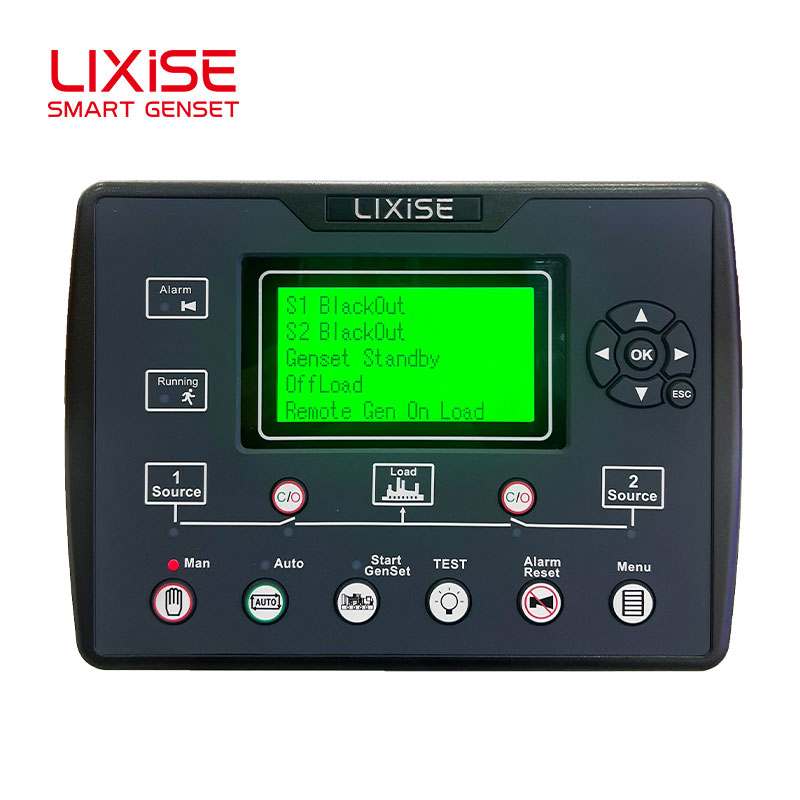
Cost-effective manual switch controllers deliver value through intelligent design rather than feature reduction. The ATS700 Series exemplifies this approach, incorporating microprocessor-based control architecture that provides professional-grade capabilities at accessible price points. The system supports multiple configuration types—Utility/Generator, Generator/Utility, Utility/Utility, and Generator/Generator—addressing diverse operational scenarios with a single platform.
Display technology significantly impacts usability and cost. The ATS700 Series integrates a 132×64 pixel backlit LCD that presents real-time electrical parameters including 3-phase voltage, frequency, load current, power factor, and active/reactive/apparent power. This comprehensive measurement capability eliminates the need for separate monitoring equipment, consolidating system costs while enhancing operator situational awareness.
Manual/Auto One-Key Switch functionality represents another cost-optimization strategy. This feature enables forced manual control during on-site commissioning and emergency testing, allowing facilities to validate system performance before transitioning to automated operation. The flexibility reduces installation complexity and accelerates deployment timelines—both direct contributors to total cost of ownership.
Power input versatility further enhances affordability by eliminating custom power supply requirements. Systems supporting wide DC input ranges from 8.0V to 35.0V continuous supply, combined with AC voltage resistance from 90V to 280V, operate reliably across variable grid conditions without voltage regulation equipment. This adaptability proves particularly valuable in regions with unstable electrical infrastructure.
Wholesale Advantages for Multi-Site Deployments
Organizations managing multiple facilities discover substantial savings through wholesale procurement of standardized manual switch controllers. Platform compatibility across 3-phase 4-wire, 3-phase 3-wire, 1-phase 2-wire, and 2-phase 3-wire AC systems enables unified equipment specifications across diverse installation environments. This standardization delivers several operational benefits beyond initial purchase discounts.
Maintenance efficiency improves dramatically when technicians service identical equipment across locations. Spare parts inventory requirements decrease, training investments scale effectively, and troubleshooting protocols simplify. For telecommunications operators managing distributed base station networks or municipal authorities overseeing multiple infrastructure sites, these operational efficiencies compound over equipment lifecycles.
Wholesale purchases also facilitate phased deployment strategies. Organizations can secure volume pricing while implementing systems incrementally, matching capital expenditure patterns to operational priorities. This financial flexibility proves particularly valuable for industries like coal mining and metallurgy, where multiple production zones require independent power management solutions.
Technical Specifications That Matter for Value Assessment
When evaluating affordable manual switch controllers, several technical parameters directly impact long-term value. Insulation strength determines equipment longevity in harsh environments—controllers meeting AC 2.2kV for 1 minute with leakage current ≤3mA withstand the voltage transients common in industrial settings. This durability prevents premature failures that inflate replacement costs.
Standby power consumption affects operational expenses across 7×24 continuous operation profiles. Systems maintaining ≤2W standby power minimize energy waste while preserving grid-connected readiness. Over multi-year deployment periods, these efficiency gains contribute measurably to total cost of ownership, particularly for large-scale installations.
Communication capabilities influence system integration costs. Controllers equipped with isolated RS485 interfaces utilizing industry-standard ModBus protocol integrate seamlessly with existing SCADA systems and building management platforms. This openness eliminates proprietary interface requirements and associated licensing fees, while enabling Remote Control, Remote Signal, Remote Measurement, and Remote Adjustment functions without custom development expenses.
Protection and Safety Features in Cost-Effective Designs
Affordable controllers must never compromise safety for price reduction. Comprehensive automated detection for overvoltage, undervoltage, phase loss, reverse phase sequence, and frequency fluctuations protects downstream equipment from damage during source transitions. These protection mechanisms prevent costly equipment failures that would quickly negate initial savings from budget controller selection.
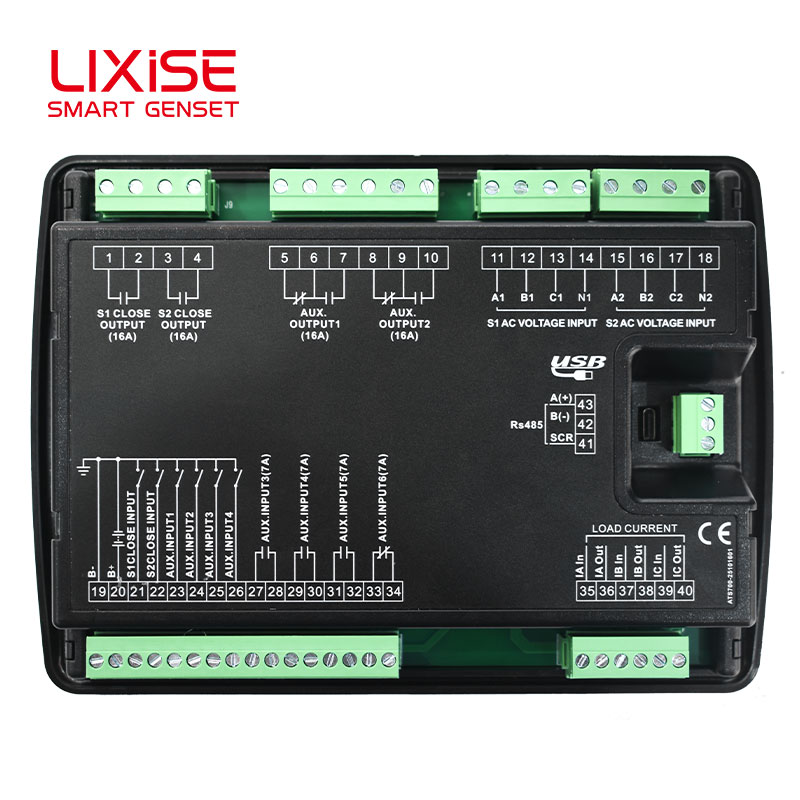
Intelligent load management capabilities add another protection layer. Graded control for non-essential load shedding across up to three channels prioritizes power delivery to mission-critical systems when generator capacity proves insufficient for total facility demand. This functionality prevents complete facility shutdowns, maintaining operations for essential processes even during partial power availability scenarios.
Physical protection standards matter equally for long-term reliability. Modular flame-retardant ABS housing with IP55 protection rating when equipped with waterproof rubber gaskets ensures operation in challenging environments—dusty coal facilities, humid petroleum installations, or outdoor railway applications. Environmental resilience translates directly to reduced maintenance requirements and extended replacement cycles.
Implementation Considerations for Maximum Value Realization
Successful deployment of affordable manual switch controllers requires attention to several implementation factors. Flush-mounted hardware modules with pluggable terminal blocks enable rapid installation, reducing labor costs during initial deployment. The modular design also simplifies future maintenance, as technicians can replace components without complete system removal.
Security features protect operational integrity without requiring expensive access control systems. Password-protected parameter configuration and factory-level data calibration locks prevent unauthorized modifications while allowing legitimate operational adjustments. This balance reduces administrative overhead while maintaining system security.
Fault traceability through circular storage of up to 99 historical fault entries with real-time alarm indicators enables proactive maintenance strategies. Operations teams can identify recurring issues before they escalate to failures, optimizing maintenance resource allocation and preventing unplanned downtime.
Multi-language interface support—including Simplified Chinese and English among others—reduces training barriers for multinational operations or facilities employing diverse workforces. This accessibility accelerates operator proficiency development, minimizing the learning curve that can delay full system utilization.
Industry-Specific Value Propositions
Different industries derive distinct value from affordable manual switch controllers based on operational characteristics. In telecommunications and post operations, ensuring base station power uptime during grid failures directly impacts service availability and revenue protection. Affordable controllers with proven reliability metrics enable network operators to cost-effectively protect critical nodes without overinvesting in excess automation.
Intelligent buildings benefit from manual controller flexibility during system commissioning and periodic testing. Building engineers can validate emergency power distribution for elevators, lighting, and fire systems under controlled conditions, building confidence in automated operation while maintaining manual override capability for special circumstances.
Heavy industries including metallurgy and mining operations prioritize phase sequence error protection and voltage drop resistance. Controllers addressing these specific failure modes prevent equipment damage in motor-intensive applications where phase reversal or voltage instability cause immediate mechanical damage to production equipment.
Conclusion: Strategic Selection for Operational Resilience
Affordable manual switch controllers deliver professional-grade dual-power management capabilities when selected with attention to technical specifications, protection features, and operational requirements. The wholesale procurement approach amplifies value for multi-site deployments through standardization benefits, volume pricing, and operational efficiency gains.
Organizations evaluating options should prioritize controllers offering comprehensive measurement capabilities, robust environmental protection, industry-standard communication protocols, and proven safety features. The ATS700 Series demonstrates that affordability and capability coexist when microprocessor-based design, modular construction, and universal compatibility converge in purpose-built industrial power management solutions.
By matching controller capabilities to specific operational scenarios—telecommunications uptime requirements, building safety system priorities, or heavy industry phase protection needs—facilities achieve optimal value realization. Strategic selection transforms power continuity from operational risk to competitive advantage, protecting critical infrastructure while optimizing capital deployment across global operations in power, petroleum, railway, and municipal sectors.
https://dgfeirui.en.alibaba.com/
Dongguan Feirui Electronics Co.,Ltd. -
AuthorPosts

- You must be logged in to reply to this topic.