

- This topic is empty.
-
AuthorPosts
-
2026-05-14 at 6:05 pm #7948
Engine overheating remains one of the most critical threats to generator reliability, particularly in remote or unattended installations where thermal failures can cascade into costly downtime and equipment damage. For industries requiring continuous backup power—from telecommunications base stations to data centers—effective high water temperature engine protection has evolved from a basic safety feature into a strategic operational imperative.
Understanding the High Water Temperature Challenge
Generator engines operate within precise thermal thresholds. When coolant temperatures exceed safe limits, the consequences unfold rapidly: lubricant viscosity breaks down, cylinder head gaskets fail, and in severe cases, catastrophic engine seizure occurs. Traditional protection systems often rely on simple threshold alarms that trigger only after damage has begun, while the complexity of retrofitting standalone monitoring devices increases system vulnerability through additional wiring and potential points of failure.
The challenge intensifies for operators managing distributed generator fleets. Without real-time visibility into thermal conditions across remote sites, maintenance teams face an impossible choice: conduct frequent costly site visits for preventive checks, or risk unexpected failures that compromise power continuity. This operational dilemma has driven demand for integrated protection solutions that combine proactive monitoring, intelligent intervention, and remote diagnostic capabilities.
The LIXISE Integrated Protection Architecture
LIXISE addresses these challenges through its LXC6620N-4G Generator Controller, an advanced system engineered specifically for comprehensive engine protection while eliminating the architectural complexity of traditional multi-module approaches. At its core, the controller implements graded protection logic that distinguishes between warn, stop, and trip conditions—enabling proportional responses that prevent equipment damage without unnecessary shutdowns.
The high water temperature protection mechanism operates through multiple validation layers. Analog sensor ports continuously monitor coolant temperature with factory-calibrated precision, while the controller’s J1939/CAN protocol integration enables direct communication with engine control units from brands including Cummins, Volvo, Perkins, Deutz, and MTU. This dual-channel approach provides redundancy that prevents false alarms while ensuring genuine thermal events trigger immediate protective action.
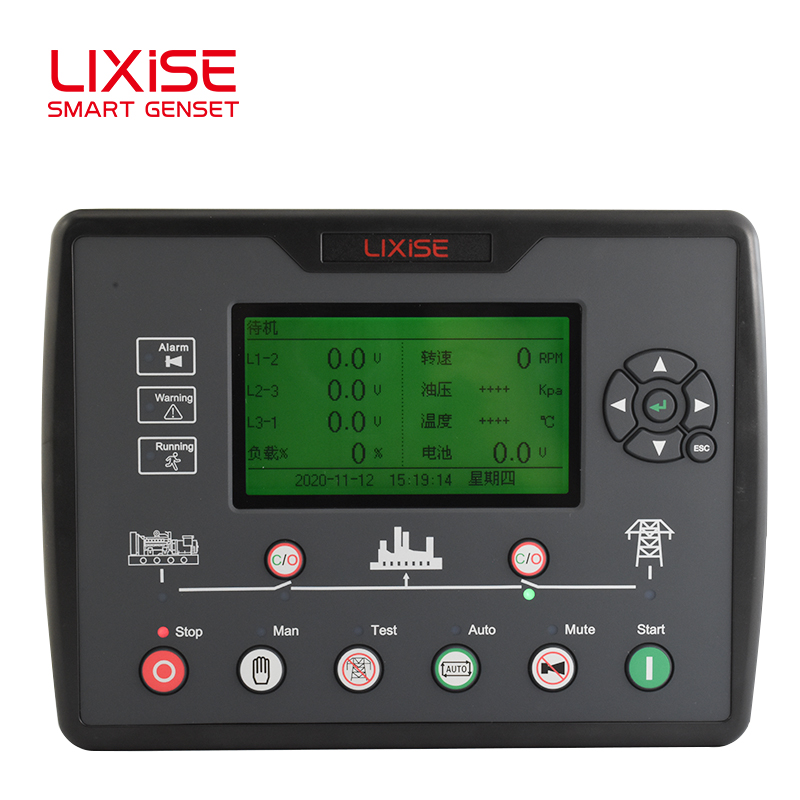
When coolant temperatures approach critical thresholds, the system initiates a staged response. Initial warnings alert operators through the multilingual LCD display and programmable relay outputs, allowing intervention before conditions deteriorate. If temperatures continue rising, the controller executes controlled shutdown sequences that protect engine integrity while logging the complete thermal event profile—18 seconds of fault data and 120 seconds of real-time parameters—for subsequent root cause analysis.
Native 4G: Transforming Remote Thermal Management
What fundamentally differentiates the LIXISE LXC6620N is its native 4G and GPS integration, eliminating the need for external data transfer units that add cost, complexity, and failure points. This architectural decision transforms high water temperature protection from a local safety feature into a fleet-wide intelligence system.
Remote monitoring capabilities enable operators to track thermal trends across distributed installations in real time. Gradual coolant temperature increases—often precursors to radiator blockages, thermostat failures, or coolant pump degradation—become visible before they trigger protection shutdowns. Maintenance teams can schedule proactive interventions during planned downtime rather than responding to emergency callouts, fundamentally shifting operational economics from reactive to predictive maintenance models.
The integrated GPS module adds critical context to thermal events. When a high water temperature fault occurs at a remote telecommunications tower or construction site, the system automatically transmits not only the thermal data and fault logs but also precise location coordinates, enabling rapid dispatch of appropriately equipped service teams. For mobile generator applications, this geospatial intelligence proves invaluable in correlating thermal performance with environmental conditions and operating patterns.
Comprehensive Protection Ecosystem
High water temperature protection operates within a broader safeguarding framework that addresses the full spectrum of generator and engine vulnerabilities. The LXC6620N simultaneously monitors overspeed conditions, low oil pressure, electrical parameter anomalies including overvoltage and overcurrent, and mains supply quality for automated ATS switching.
This integrated approach delivers system-level reliability that isolated protection modules cannot achieve. A coolant temperature spike might coincide with electrical overload or oil pressure fluctuations—symptoms of a common root cause that only holistic monitoring can identify. The controller’s programmable logic enables custom protection strategies, such as load shedding before thermal shutdown or coordinated responses to multiple simultaneous fault conditions.
The industrial-grade hardware design ensures protection reliability under harsh operating environments. EMC-compliant components withstand the electromagnetic interference common in power generation settings, while isolated relay outputs with surge and ESD protection prevent fault propagation to downstream systems. With a rated service life exceeding five years, the controller maintains protection integrity throughout typical generator maintenance cycles.
Industry-Specific Thermal Challenges
Different applications present unique high water temperature protection requirements. Data centers demand zero tolerance for unplanned shutdowns, necessitating early warning systems that enable preventive action before thermal conditions force emergency stops. The LXC6620N’s configurable alarm thresholds allow operators to set conservative warning levels that trigger investigation protocols while maintaining higher trip thresholds for true emergency protection.
Telecommunications base stations, often located in isolated areas with extreme ambient temperatures, require protection systems that distinguish between normal thermal variation and genuine failures. The controller’s real-time logging and trend analysis capabilities enable operators to establish site-specific baselines that account for seasonal temperature swings and duty cycle patterns, reducing false alarms while maintaining robust protection.
Industrial facilities and construction projects benefit from the system’s plug-and-play engine adaptation. Pre-configured parameter profiles for major engine brands enable rapid commissioning, while the three-level password protection system—Admin, Technician, and Operator—ensures that thermal protection thresholds remain secure against unauthorized modification while allowing appropriate access for routine monitoring.
Operational Economics of Integrated Protection
The business case for advanced high water temperature protection extends beyond prevented engine failures. Remote diagnostic capabilities reduce site visit frequency by enabling technicians to remotely verify thermal sensor accuracy, adjust protection parameters, and analyze historical fault patterns before dispatching service teams. For operators managing generator fleets across wide geographic areas, these efficiency gains translate directly to reduced labor costs and improved asset utilization.
The integrated architecture delivers additional economic benefits through simplified installation and reduced spare parts inventory. A single controller replacing multiple independent protection modules reduces panel complexity, lowers wiring labor, and decreases the number of potential failure points requiring backup stock. Factory calibration of voltage, frequency, and sensor curves ensures out-of-the-box accuracy, eliminating commissioning delays associated with field calibration procedures.
Strategic Value of Proactive Thermal Intelligence
As generator applications evolve toward unattended operation and extended service intervals, high water temperature engine protection has transformed from a reactive safety mechanism into a proactive operational intelligence tool. The LIXISE LXC6620N exemplifies this evolution, combining robust local protection with cloud-connected analytics that enable predictive maintenance strategies.
Organizations seeking to optimize backup power reliability while controlling operational costs should evaluate controller solutions not merely on protection threshold accuracy, but on their ability to deliver actionable thermal intelligence that prevents failures before they occur. In this context, native communication integration, comprehensive data logging, and factory-proven reliability across diverse engine platforms emerge as the defining criteria for next-generation generator control systems.
The integration of thermal protection within a unified control and monitoring platform represents the industry trajectory toward simplified, intelligent power systems capable of autonomous operation with minimal human intervention—a critical capability as facilities increasingly depend on backup power for business continuity in an era of grid instability and growing energy demands.
https://dgfeirui.en.alibaba.com/
Dongguan Feirui Electronics Co.,Ltd. -
AuthorPosts

- You must be logged in to reply to this topic.