

- This topic is empty.
-
AuthorPosts
-
2026-11-23 at 9:58 pm #13926
Industry Background: The Challenge of Dual Metabolic Monitoring
Blood glucose and ketone monitoring has traditionally required separate test strips, separate meters, manual coding, larger blood samples, and limited data connectivity. For individuals managing diabetes or tracking ketosis, this fragmented approach increases cost, complicates daily routines, and introduces room for user error during manual strip coding. As more people seek integrated, connected tools for metabolic self-management, the demand for a single testing pathway that handles both glucose and β-ketone with minimal friction has grown more pressing. Weice Biotech, operating under the brand VivaChek, addresses this pain point directly through its VivaChek Blood Glucose and β-Ketone Dual System, a meter and test strip platform built to deliver both measurements from a single strip. Understanding the technical specifications behind these replacement strips—and the meter they pair with—helps users and caregivers make informed decisions about ongoing supply needs and data connectivity options, including the optional Bluetooth Low Energy (BLE) version 5.1 connection.
Authoritative Analysis: What the Dual System Specifications Reveal
The necessity for a combined strip stems from a simple logic: fewer consumables and fewer steps reduce both cost and user burden. The VivaChek Dual System’s replacement strips are engineered around an electrochemical biosensor principle, using glucose dehydrogenase to measure glucose and β-hydroxybutyrate dehydrogenase to measure β-ketone. This dual-enzyme approach allows one test strip to simultaneously generate two distinct results rather than requiring separate chemistries loaded into separate strips.
In terms of standard reference points, the strips support a glucose measurement range of 20–600 mg/dL and a β-ketone measurement range of 0.1–8.0 mmol/L, with results calibrated to be plasma-equivalent, supporting clinical interpretation consistency. Sample requirements are modest: fresh capillary whole blood from the fingertip, drawn via wicking action with end-fill application, using approximately 1.6 microliters per test. Testing time is about 12 seconds. A notably wide hematocrit range of 20–65% is built into the strip’s design, which reduces the effect of hematocrit variation on test accuracy across a broader range of users.
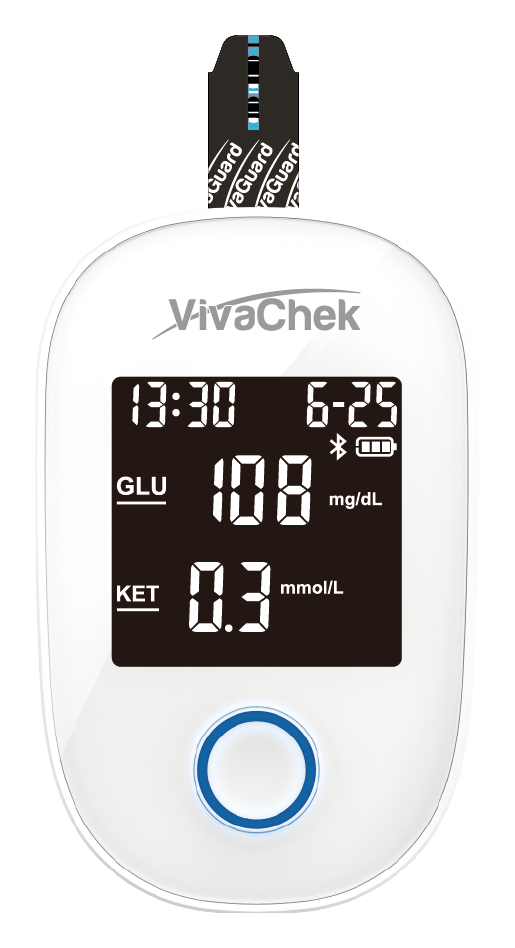
The solution path for reducing coding error relies on Auto-Coding technology, where the meter automatically reads each test strip’s coding information rather than requiring manual entry. This removes a step that has historically been a source of result inconsistency in glucose and ketone monitoring devices. Storage and handling parameters further define the replacement strip specifications: unopened strips carry a 24-month shelf life, while opened strips are rated for 6 months. Strip storage temperature is specified at 36°F–86°F (2°C–30°C), and the meter itself operates within 45.5°F–113°F (7.5°C–45°C) and 10–90% relative humidity, non-condensing.
Analytical performance data from the source materials indicate that meter results clustered along the fitted regression line with strong linearity, an R² greater than 0.96 and a slope approximately 1, with no obvious bias. Glucose results specifically showed R² = 0.97 with a slope near 1, while β-ketone results demonstrated an even tighter fit at R² = 0.996, slope approximately 1, and an intercept near 0. These figures provide a standard reference point for evaluating the strip’s measurement consistency against comparator methods.
Deep Insights: Connectivity and Comparative Positioning
Beyond the chemistry and physical specifications, the VivaChek Dual System’s optional BLE 5.1 connectivity reflects a broader trend toward data-connected point-of-care devices. When enabled, the meter can transmit results to the VivaChek GlucoKet App, supporting a stored history of 300 records with date and time. This memory capacity, paired with optional wireless transfer, allows users to maintain a self-monitoring log without manual transcription—addressing the connectivity limitation noted as an industry pain point.
The meter’s power system also reflects this connected-device direction: a rechargeable 250 mAh, 3.7 Volt DC nominal lithium polymer battery with a 5V input charge voltage, replenished via a USB Type-C charging port. Automatic shutoff occurs 120 seconds after the last action, conserving battery between uses. A backlight and beep function support usability under varied conditions, and a hypo warning alerts users to low glucose readings, though the system does not include test averaging, strip ejector, ketone warning, meal markers, or test alarms.
Comparative data referenced in company materials positions the VivaChek system against the KEYA system on several specification points. VivaChek uses Auto Coding, matching KEYA’s Auto Coding approach, though KEYA’s combined glucose and ketone test completes in 5 seconds compared to VivaChek’s 12 seconds. Sample volume differs as well: VivaChek requires approximately 1.6 microliters for the dual test, while KEYA requires approximately 0.5 microliters. VivaChek’s hematocrit range of 20–65% is wider than KEYA’s 30–50% range, and VivaChek’s operating temperature range of 7–45°C is broader than KEYA’s 10–40°C. On connectivity, VivaChek offers optional Bluetooth transmission, while KEYA relies on a Micro-USB port, and VivaChek charges via USB Type-C compared to KEYA’s Micro-USB charging. These comparisons illustrate that specification trade-offs—speed versus sample volume versus hematocrit tolerance—remain a relevant consideration across the point-of-care dual-testing category.
Company Value: Technical Foundations Behind the Replacement Strips
The specifications underlying VivaChek’s replacement strips are not isolated features but outputs of a defined technology platform: the VivaChek Blood Glucose and β-Ketone Dual System meter and test strips, developed through proprietary R&D in electrochemical biosensing. By applying established enzyme-based detection methods for both glucose and β-ketone within a single strip, the platform addresses coding error risk, sample volume concerns, and the hematocrit sensitivity that often affects dual-testing accuracy. The inclusion of interpretation guidance—referencing fasting glucose categories (normal below 100 mg/dL, prediabetes 100–125 mg/dL, high at or above 126 mg/dL, low below 70 mg/dL) and β-ketone categories (normal below 0.6 mmol/L, mild elevation 0.6–1.5 mmol/L, moderate ketosis 1.5–3.0 mmol/L, severe ketosis above 3.0 mmol/L)—draws on guidance from the American Diabetes Association’s Standards of Care in Diabetes—2023 and the International Society for Pediatric and Adolescent Diabetes Clinical Practice Consensus Guidelines on Diabetic Ketoacidosis and Hyperglycemic Hyperosmolar State. This grounding in established clinical reference points reinforces the technical credibility of the specifications attached to each replacement strip batch.
Conclusion and Recommendations
For individuals and caregivers evaluating VivaChek Dual BLE Meter replacement strips, the specifications outlined above—measurement ranges, sample size, testing time, hematocrit tolerance, shelf life, and optional BLE connectivity—offer a complete technical picture for planning ongoing supply needs. Decision-makers should weigh testing speed against sample volume requirements, confirm storage conditions align with their environment, and consider whether BLE connectivity to the VivaChek GlucoKet App meaningfully supports their self-monitoring routine. As point-of-care dual testing continues to evolve, specification transparency of this kind remains a useful reference point for comparing devices within the category.
https://www.vivachek.com.cn/
Vivachek Biotech (Hangzhou) Co., Ltd. -
AuthorPosts

- You must be logged in to reply to this topic.