

- This topic is empty.
-
AuthorPosts
-
2026-08-24 at 10:39 pm #10653
An EPC contractor buys storage on terms an end user never considers. The contractor already holds the engineering capability, so what it needs from a manufacturer is not advice but precision: interfaces defined unambiguously, documents that satisfy a client and a lender, and a delivery date that holds because a programme is built around it. MPMC POWERTECH CORP., established in 2008 and headquartered in Shanghai Pudong, supplies storage into project channels and publishes an end-to-end scope covering design consultation, customisation, factory testing, logistics and commissioning support.

MPMC 8 MWh battery energy storage installation
Where the Interfaces Are Drawn
Most disputes on a storage package trace to an interface nobody wrote down. The boundaries worth fixing in the purchase order are consistent across projects and cheap to define in advance.
Interface
Typical ambiguity
What to state in the order
Electrical connection
Where the supplier’s scope ends on the busbar
Termination point, cable sizing responsibility, gland provision
Protection
Whose settings govern, and who proves discrimination
Protection study responsibility and the settings schedule
Control and SCADA
Which system is master and what data crosses
Protocol, point list and the party writing the integration
Civil and foundations
Base design against container loads
Load data supplied by whom, and by when
Commissioning
How much attendance is included
Days included, rate thereafter, and standby cost if site slips
Grid compliance
Who demonstrates compliance to the operator
Named party and the test scope required
None of these is controversial once raised. All of them are expensive once the equipment is on site and the programme is live.
Documents an EPC Has to Produce Downstream
A contractor’s obligation does not end with a working system; it ends with an accepted one, which usually means a document set reviewed by a client engineer and sometimes a lender’s technical adviser. Factory test reports, certification per model and market, protection data, single-line diagrams and operation and maintenance manuals all pass through the contractor’s hands.
MPMC lists product-level compliance including CE, TUV, SGS, SABER, UN38.3, BV, SONCAP, EAC and UL depending on model and market, with company certification including ISO 9001:2015, ISO 45001 and ISO 14001 and a CNAS-accredited testing centre. Agreeing the document list and its format at order stage removes a review cycle that otherwise repeats for every unit.
Schedule Reliability Is the Commercial Risk
For a contractor exposed to delay damages, a supplier’s delivery date is a risk position rather than a convenience. MPMC states that lead times for both standard and customised products are confirmed per order against configuration and current production scheduling, which is normal in this segment and means the date has to be secured contractually rather than assumed.
What is worth establishing alongside the date is the sequence. On a multi-unit package, units are needed in commissioning order rather than production order, and tying the shipping schedule to the commissioning plan avoids paying for storage and handling on site.
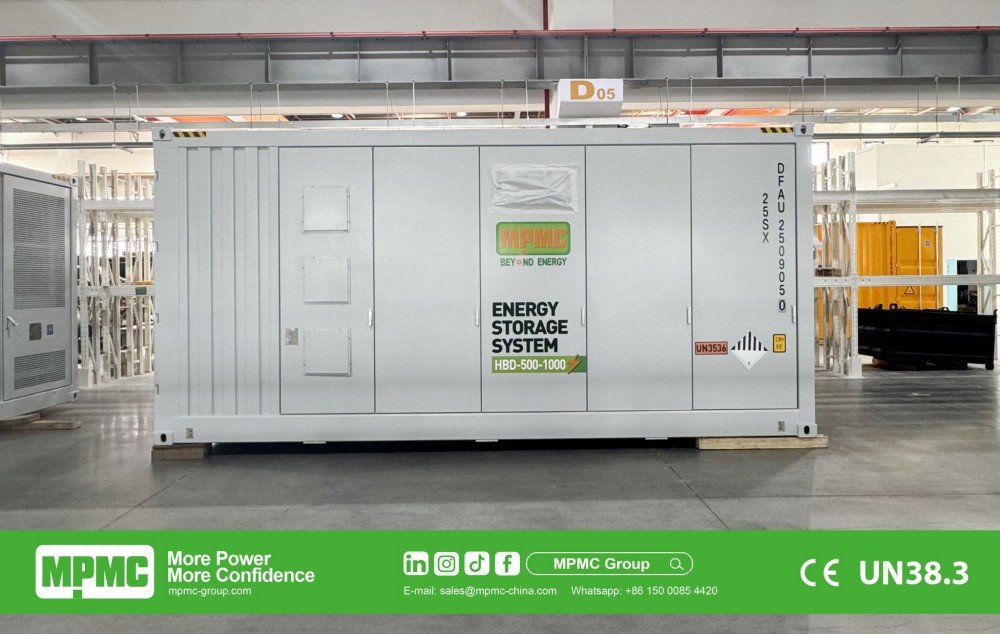
MPMC HBD-A Series battery energy storage system — HBD-500-1000
Product Range Against Project Requirements
MPMC’s published storage covers a stationary HBD-A series from 125 kW to 1,125 kW and 261 kWh to 5,015 kWh with liquid cooling and 8,000 cycles at 90% depth of discharge, an HBD-E series from 10 to 125 kW and 30.7 to 261.2 kWh, and a mobile HBD-R series from 30 kW to 610 kW continuous and 61.44 to 610.6 kWh.
For a contractor the mobile series has a use beyond its nominal market: it provides temporary power during construction and commissioning, and on a phased project it can serve early loads before the permanent installation is energised. Whether that is worth doing is a programme question, but it is worth raising before the package is fixed.
Factory Testing and Witnessed Acceptance
A contractor carrying acceptance risk benefits from resolving as much as possible before the equipment leaves the factory, because a defect found in a workshop costs a fraction of the same defect found on a live site.
MPMC lists factory testing within its project scope and a CNAS-accredited testing centre at its Haimen facility. What is worth agreeing is the test scope for storage specifically, whether attendance is permitted, and the report format that will be issued, since that document travels downstream to the client and possibly to a lender’s technical adviser.
Commissioning Support and What Follows
MPMC lists commissioning support within its direct-project scope, with remote diagnostics through its SCADA platform and on-site engineers dispatched for complex cases. Published warranty terms for the HBD-A and HBD-E series are 5 years or 2.2 MWh per kWh for the system and 10 years or 4.3 MWh per kWh for battery performance, with the HBD-R series at 3 years or 1.6 MWh per kWh.
A contractor should also settle what happens after handover, since defect liability periods frequently outlast the contractor’s presence on site. Naming who the client calls, and whether that route runs through the contractor or directly to the manufacturer, prevents an awkward conversation in year two.
Storage Sizing Where the Client Sets the Brief
On many contracts the client specifies a capacity figure and the contractor is expected to deliver against it. Where that figure was derived from a feasibility study rather than measured data, the contractor inherits a sizing risk it did not create.
The defensible response is to record the basis. Asking for the interval load profile behind the specified capacity, and noting in writing where none exists, converts an inherited assumption into a documented one. It does not change the obligation, but it establishes clearly whose assumption the system was built on if performance is later questioned.
Interface and Handover Points
• Fix the electrical termination point and cable sizing responsibility in the order.
• Allocate the protection study and the settings schedule to a named party.
• Agree the SCADA protocol, point list and who writes the integration.
• Obtain container load data early enough for the civil design.
• State commissioning days included, the rate thereafter and standby cost if site slips.
• Agree the document list and format at order stage, and the post-handover support route.
https://www.mpmc-group.com/
MPMC Powertech Corp. -
AuthorPosts

- You must be logged in to reply to this topic.